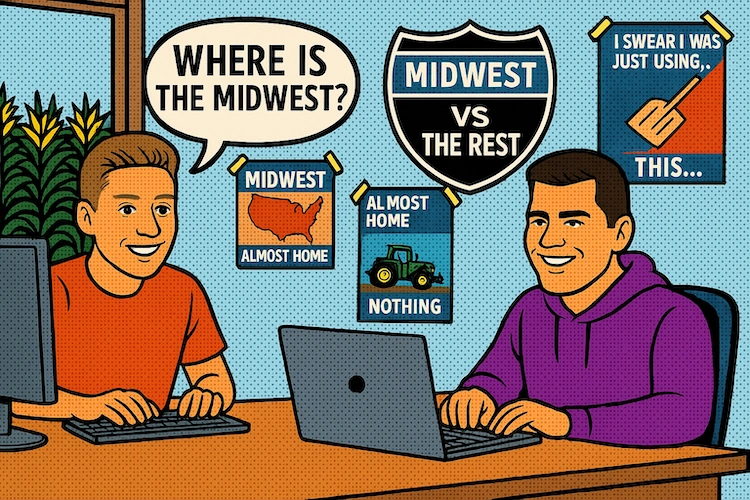
According to the two subjects of this story, teenagers who grow up in Iowa often hear the same refrain: when you graduate… you leave. But Bryce Bortscheller and Scott Burak never planned on it. Not even to one of the neighboring states of Minnesota or Wisconsin or Illinois… we wonder. At least then we wouldn’t have to explain why we’re sharing the story of founders from a state that technically, we don’t cover on StartMidwest. “Is Iowa even in the Midwest?” I asked them, jokingly, and was directed - with a smile - to one of the many maps they share on their pages.
This story and this question all make sense when you consider who these two are and what they’ve built. Their media company, Map Dot Media, runs two brands and multiple social accounts which share the joy, fun and sometimes even the pain of being a Midwesterner. Their posts, memes and videos (often provided by their own audience, alongside those created in-house by their team)… reach millions. And they’re coming to the Midwest House Summit this week in Grand Rapids, Michigan (tickets still available!) Therefore it seemed like the ideal time to share the story of these unconventional entrepreneurs.
Which brings us back to Iowa. Bryce never planned on leaving: “born in Iowa, lived in Iowa my whole life, and I don’t plan on leaving anytime soon,” while Scott was born in California, but moved when he was two to live on his family’s century farm - land kept in the family for over 100 years. “I’m honorably born and raised in Iowa,” he says, laughing at the phrasing.
They didn’t grow up dreaming of leaving, but nor did they think they’d be building a media empire in the Hawkeye state.
Bryce wanted to be a pro athlete. Basketball or football, he didn’t care which. He chased it all the way to Division III scholarship offers before realizing, “I didn’t have the speed or the height… so I hung the jersey in the rafters and said maybe I’ll just go to school and be a normal person.”
Scott, meanwhile, had an even more unconventional vision of his potential future for a kid from a 150-student school district. “I wanted to be a YouTuber… that was very unique at the time in 2004 or 2005,” he said. His first-ever income? A $25 check from the YouTube Partner Program. “I thought I was rich”.
Two Iowa kids. One dreamed of sports. The other dreamed of pixels.
Neither dreamed of entrepreneurship.
Neither dreamed of staying.
And we weren’t looking for Iowa entrepreneurs for a Founder Story… and yet here we all are.
That Day at the Capitol
The story of Midwest vs The Rest starts long before that name was even a glint in a lawyer's eye. Back when their first brand, Iowa Chill, was nothing more than a fast-growing college meme page and four friends were trying to figure out what to do with it.
The four founders of Map Dot, Midwest vs., Iowa Chill et al are Bryce and Scott and their friends Nathan ‘Nate’ Krieps and Darian ‘DJ’ Jones. They all had different skills. Nate ran the original Iowa Chill account. Bryce had the creative eye. DJ handled financial logic. Scott had a web design hustle and marketing instincts.
Scott says that Bryce noticed the opportunity before anyone else did. “Let’s put all these people in the room and figure out how to make money,” he remembers him telling the group.
Their first attempt at monetization?
Promoting ticket sales for a 2 Chainz concert. It didn’t make any money, but all four went to the concert effectively. Scott recalls the rapper performing in a wheelchair and says he “gave the performance of a lifetime.” I detect a tongue wedged firmly in his cheek, but we move on.
This wasn’t a business, but it was a spark.
Then, two days before Thanksgiving 2017 - and just 48 hours before Black Friday - Scott stood on the steps of the Iowa State Capitol, filing an LLC so they could get an EIN number and open a business bank account in time for their first merch drop.
“We made a couple thousand bucks that first Black Friday… and we thought: boy, we’re in business,” Scott said.
The next week, the team sat on the floor of a borrowed office stuffing those pre-orders and rewriting every mailing label that Nate had handwritten. IYKYK.
The Iowa Advantage?
Across the Midwest, founders often talk about “community”, but in talking to these guys it sounds like Iowa’s version is something else entirely.
The region’s entrepreneurial ecosystem impacted the team early. Both were part of the John Pappajohn Entrepreneurial Centers, a set of programs across Iowa that support founders as young as 16, set up by the successful local entrepreneur, John Pappajohn. At the University of Northern Iowa, both were selected for the Okoboji Entrepreneurial Institute - a week-long immersion where successful Iowa founders open their homes to students in and around the Iowa lake of the same name.
“They opened up their doors to us… they just wanted to sit down and talk to us and learn about us,” Scott recalled. “You’re getting out of your comfort zone staying in some random person’s house… but they treated everyone with so much respect”.
These weren’t small-town businesses hosting them. When I ask, Bryce estimated the group included people in the $10–100M range. The takeaway isn’t the money though, it is that business success in their own state is achievable. “It demystifies it,” he adds.
This is one of the most interesting takeaways from this conversation. They make Iowa sound like a place where successful entrepreneurs will actually bring you into their home, even give you a room, while walking you through their business playbook without asking for equity or anything in return. “They weren’t bragging,” he says, “they were just proud of the people they hired and the network here.”
In a coastal ecosystem and maybe even other parts of the Midwest, this might be an accelerator with an equity ask. In Iowa, it comes in the form of a dinner with people who genuinely want you to win.
The Hard Pivot From Parties to Professionalism
In the early years, their social accounts grew quickly, but the content was chaotic. User-generated posts often came from bars, barn parties, basement stunts, or college houses. It was viral, but messy. And eventually, in their view, it was misaligned with the kind of brand equity they were trying to build.
“As we got more mature, naturally we moved away from that scene,” Bryce said. “We know attention online is valuable… and we realized we needed to deploy our resources toward something we could scale.”
The turning point came in 2020 during the pandemic, when the entire world went online, and Midwest audiences exploded. “We started to establish ourselves as a legitimate voice in the Midwest,” according to Bryce. So they professionalized the business, and the sponsorship dollars started catching up to the follower count.
It seems like the appropriate moment to ask what advice they wish they’d had at the beginning. Bryce doesn't hesitate: “Stay focused… know what you do really well and lean into that.”
He says they had chased too many shiny objects early on: promoting artists, flirting with sports agency aspirations, throwing parties, imagining festivals. All of them seemed attainable, but that focus helped them become a real business. It wasn’t until they decided to own their niche - an authentic, witty, culturally-tuned Midwestern voice - that the business compounding began. Consistency has been their superpower. A decade of posting twice or three times a day, on every platform, no matter what.
How They Think About Content (and Why AI Won’t Replace Them)
The way they explain their creative philosophy should resonate with almost every founder, trying to be seen in a saturated market. “We want to bring a spark of light to people’s timelines… we want to make people laugh,” Scott said. Joy-forward, Community-first and the opposite of snark, outrage, or political bait.
And the takeaway for the rest of us in the age of AI? It’s deeply human. Something that Bryce argues the tech may always have a problem of replicating. “It’s hard to tie in those moments like… why did we all sit at the kids’ table at Thanksgiving? There are little human woven pieces that make it so much more than what AI can do right now.”
Grandma’s good bowls. Driving 10 hours for a vacation. Walking tacos. Barn cats. A gas station that somehow has the best pizza in the county.
It’s anthropology as much as it is content.
The Business Within the Humor
If you stripped away the jokes and memes, what you’d find underneath is a very serious business.
Across Midwest vs The Rest and Iowa Chill the business has:
- 2.6 million+ followers across its accounts
- A sponsorship engine that’s become sophisticated and repeatable
- A growing podcast they now confidently include in brand decks
“We can talk to people who are actually going to purchase your product in this region,” Bryce said of Map Media’s approach.
That’s the business insight that we can agree with, it's the thing that outsiders often miss. The Midwest is a massive, under-targeted, under-loved, high-spend consumer market.
And these guys reach it better than nearly anyone.
Why They Believe in the Midwest (and Why They Stayed)
When I asked what Iowa’s greatest forgotten asset is, Scott answered without hesitation: Respect for your neighbors, discipline, hard work.
“You grow up on a farm and you’ve got to rely on your neighbor to borrow equipment or a bag of sugar… that level of respect - if you are willing to apply it - gets you into the circles worth being in,” he said.
Bryce was more existential: “It feels awesome to celebrate the region… we have this very cool thing that’s underrepresented, and even if we weren’t raking in the dough, for a lack of a better term, because this space was underutilized … it felt prideful to represent our people,” he said.
The Real Story
In the end, Midwest vs The Rest is not an algorithm play.
It’s not comedy for its own sake.
It’s not nostalgia for nostalgia’s sake.
It’s two young founders who stayed and built something that represents the place they love.
It’s a business that should not have worked on paper… but did, because they kept showing up.
And it’s one of the clearest signs we have that the Midwest is not just growing its entrepreneurship ecosystem, but building its own cultural canon. One meme at a time.