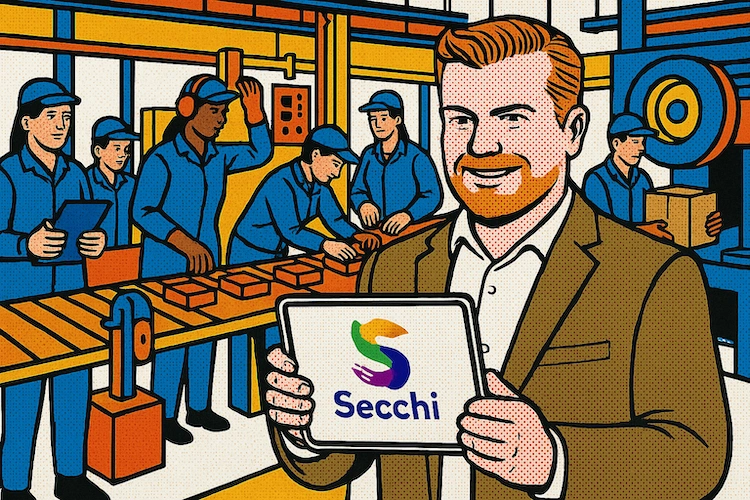

Mike White has a simple way of talking about what he is trying to change: the gap between what leaders say they value and what actually happens on the front line. His company, Secchi, lives in that gap.
Before we go any further, it helps to define who Secchi is really for. When Mike says "non-desk workers," he means the people who do their jobs on a line, on a floor, in a truck, in a warehouse, on a site. They do not sit in front of a laptop all day. They punch in, gear up, and keep physical operations running. They are production workers, machine operators, assemblers, material handlers, technicians, nurses - the people most corporate strategies depend on, and the people most corporate tools tend to overlook.
Secchi is built for them, and for the supervisors who lead them.
From Corporate Comfort to Startup Risk
Mike did not start out as a founder. He spent years in the corporate world leading teams in a complex, cross functional, multinational environment. In that setting, he learned how to manage performance, influence across departments, and navigate the politics that come with any large organization.
By his own account, he considered himself a capable leader. He could hit goals, manage expectations, and move through the system. But something kept nagging at him.
He saw how much of the real work happened away from conference rooms and screens. He watched front line supervisors juggling impossible demands: keeping production on track, handling attendance issues, coaching new hires, managing interpersonal drama, all while staying on top of quality and safety. He watched non-desk workers get reduced to numbers in a report, even though their daily experience was messy, human, and full of moments that never made it into any system.
Over time, he came to a blunt conclusion: the tools and habits that corporate leaders use to manage people simply do not fit the reality of hourly, non-desk work. The people doing some of the most important jobs had the least support when it came to communication, recognition, and performance clarity.
That is the fracture line that turned Mike from a corporate leader into a founder.
Leaving his steady role was not glamorous. He is very honest about that. The startup world meant learning a fresh set of skills almost overnight: fundraising, budgeting, managing cash flow, building a new business model, selling directly to customers. The paycheck became inconsistent. The stress went up.
His advice to anyone romanticizing the leap is direct: keep your day job as long as you can, because everything takes longer than you think. Be ready for sacrifice, especially if you are walking away from a comfortable corporate salary. His high school football coach's line runs through his head often: "If it were easy, everyone would do it, and anything worth doing is hard."
What pushed him forward anyway was a conviction that the people on the floor deserved better, and that he had seen enough up close to design something that might actually help.
What Secchi Actually Does For Non-Desk Workers
Ask Mike what Secchi is and he will likely skip the buzzwords. At its heart, Secchi is about helping front line leaders manage relationships with non-desk workers in real time. Not once a year at review time, not only when someone is in trouble, but every shift, every interaction.
A big part of that is simply making it easier for supervisors to document what is happening with their people. Recognition, coaching, attendance, discipline, all the short conversations that are usually lost in the noise. When those things get captured in the moment, they turn into a clear picture over time, rather than a fuzzy memory when HR needs a record or promotion decisions are being made.
The impact shows up first in something very practical: time.
Supervisors tell Mike that workers come back to the same issues "three to five times a night." The same questions, the same arguments about who was late, who swapped shifts, who called in. That cycle eats up energy and attention. When Secchi gives supervisors a simple way to track and show what actually happened, it cuts out a lot of that back and forth. Mike estimates that they immediately free up about ten percent of a supervisor's time from that "whole drama."
Instead of constantly rehashing the past, supervisors can spend more time on the work in front of them and the people who are doing it.
Texting That Treats Workers Like Adults
One of the most tangible examples of Secchi's approach is its texting tool.
Texting is not new. There are plenty of apps that let companies send mass messages to employees. What Secchi does differently is put the power in the hands of the front line supervisor, with guardrails that fit reality.
Supervisors can text only the employees they are responsible for. Companies do not have to buy a new seat or a fancy add on, and they are not opening up a free for all group chat that becomes more of a distraction than a help. It is a simple, controlled way for leaders to reach their teams quickly.
Mike shared a story about a customer whose facility sits near a bridge. One day that bridge went out without much warning. For anyone on the second shift, the normal commute suddenly got twenty minutes longer.
In the old world, that would mean a wave of late arrivals, confusion at the time clock, and possibly a lost chunk of production time. Instead, the supervisor pulled up Secchi and texted everyone on the shift:
"The bridge is out. It is going to take an extra 20 minutes to get to work. You need to go around this way, but you are still expected to be on time."
In a single message, they gave people real information, set a clear expectation, and protected production hours. They also sent a quiet but important signal to their non-desk workers: you deserve to know what is going on, and we are going to tell you in a timely, direct way.
For a workforce that is often the last to hear about changes, simple, well used texting can feel like a big step toward respect.
Trust, Incentives, and the Dilly Bar Story
If you spend time with Mike's YouTube shorts and podcast appearances, a theme emerges: he cares about how non-desk workers feel, not just what they produce. He talks about the emotional side of work, about how "feelings decisions" and "data decisions" are always tangled together, and about his belief that everyone is a leader in their own sphere.
One of his signature stories is the "Dilly Bar" story. It is a small story about incentives that reveals a lot.
In many plants, the traditional way to "incentivize" people is with big, occasional rewards that tend to go to the same visible high performers. Mike argues for a different approach, one that looks a lot more like a Dilly Bar from Dairy Queen than a steak dinner. Lower stakes, more frequent, spread across more people. The goal is not to crown a hero once a quarter, but to create a steady drumbeat of recognition that tells non-desk workers, "We see you."
That philosophy connects closely with Brené Brown’s idea that “trust is built in very small moments.” Mike is effectively trying to bake that into the way supervisors operate. When tools make it easier to notice and record the right things in the moment, trust can grow in the same way: one thank you, one honest conversation, one fair correction at a time.
Secchi, in that sense, is less about policing and more about making it possible to lead in a way that matches what companies say they value.
A Different Kind of Leadership Test
What is interesting about Mike's founder journey is how much it has reshaped his own understanding of leadership.
In his corporate life, leadership meant balancing results with politics and expectations. The system was large and somewhat cushioned. There were budgets, departments, support functions. If something went wrong, there was usually a buffer.
In the startup world, there is no buffer. He has had to learn how to pitch investors, manage a run rate, prioritize product features, and stay close to customers who will tell him very quickly if something does not work. The margin for error is smaller, and the feedback loops are faster.
At the same time, he has discovered a deeper form of trust with his small team. "We have developed a product our customers love," he says, "but leadership in this arena takes more trust and faith in each other than the corporate world." There is nowhere to hide. Everyone's work shows up in the day's progress.
That experience has sharpened how he thinks about the non-desk workers he serves. If he, as a founder, feels the weight of uncertainty and the need for clear communication, how much more do workers feel it when they do not control the schedule, the machinery, or the market?
It reinforces his belief that clarity is not a luxury. It is a condition for dignity at work.
The Future of Work Where There Are No Desks
When people talk about the "future of work," they often picture remote meetings, digital nomads, and office software. Mike is working on a future that looks very different. His future is loud, physical, and time bound. It smells like metal, chemicals, food, or motor oil. It is governed by shift changes, not calendar invites.
In that future, non-desk workers are not an afterthought in HR systems. They are the primary users. They get clearer expectations, more consistent recognition, and faster, more respectful communication. Supervisors are not drowning in paperwork and drama. They have tools that match the speed and intensity of their environment.
None of this is about making every plant or warehouse "feel like a tech company." It is about giving non-desk workers the same basic things knowledge workers have come to expect: to be informed, to be seen, and to have their performance judged on reality rather than rumor.
For Mike White, that is the point of Secchi. It is not just another app. It is a bet that if you give the people who never sit at a desk better tools and more honest feedback, you do not just improve metrics. You change what it feels like to go to work.
And if he is right, the most important part of the future of work will not be happening on screens at all. It will be happening on the floor, in the plant, on the line, where it has always mattered most.
Angela Damiani is a serial entrepreneur and community builder based in Milwaukee, Wi. Since 2009, she has co-founded and led multiple ventures, including NEWaukee, and is an active curator of the Midwest Founders Community. She writes about the realities and possibilities of building companies in Wisconsin and the broader Midwest.