
Become a member & keep reading for free, or choose a paid membership.
Access all our content & email newsletter

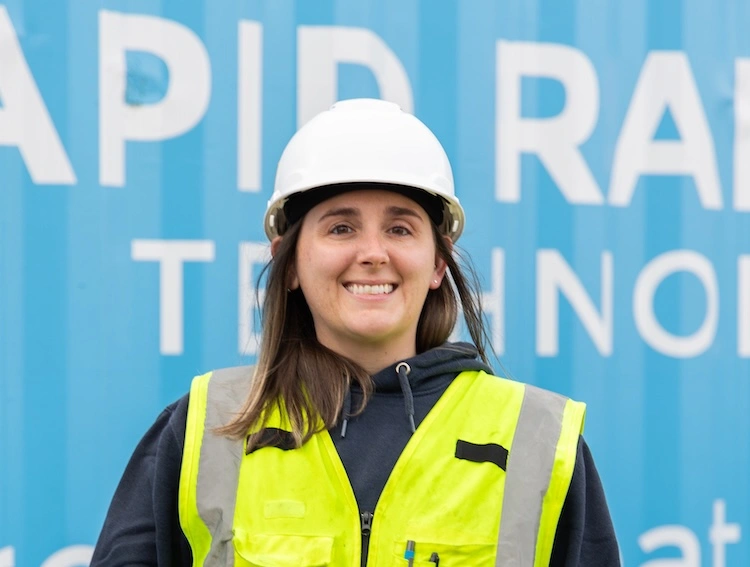
There is a moment that many founders can point to when an abstract problem becomes personal. For Paige Peters, that moment came in 2010, when severe storms hit Milwaukee and overwhelmed aging sewer systems, flooding basements and sending untreated wastewater into Lake Michigan. It was not a theoretical issue or a distant climate warning. It was happening in real time, in her city, to people she knew.
That experience planted the seed for what would eventually become Rapid Radicals, a Milwaukee based water technology company rethinking how wastewater treatment works, how fast it can happen, and where it can be deployed.
Paige did not originally set out to build a company. Her early aspirations pointed toward global service, with interest working for organizations like the UN or WHO. But while pursuing graduate research alongside her advisor Dr. Dan Zitomer, she found herself drawn into a very specific engineering challenge. How do you treat water quickly, locally, and effectively when conventional systems are too slow, too large, and increasingly misaligned with the realities of climate change?
Rethinking Wastewater From the Ground Up
Traditional municipal wastewater treatment relies on biological processes such as activated sludge. These systems are proven, but they are slow, often requiring many hours of treatment time, and they depend on massive centralized infrastructure.
Rapid Radicals takes a fundamentally different approach.
Through academic research supported by the National Science Foundation and industry partners, Paige and Dan developed a non biological wastewater treatment system capable of meeting regulatory discharge requirements for organics, solids, and bacteria in under 20 minutes. That is roughly 20 times faster than conventional treatment and requires about 95 percent less physical space.
What began as a research proof of concept quickly drew attention from industry mentors. The technology worked. The performance data held up. And the question shifted from whether the solution was viable to how it could be scaled responsibly.
Within a month of presenting early results, Paige founded Rapid Radicals.
Building a Company at the Pace of Infrastructure
From the beginning, Rapid Radicals lived in a space that does not align neatly with startup mythology. This was not a lightweight software product or a consumer gadget. These were large scale manufactured systems. Capital intensive. Regulated. Slow to pilot and slower to adopt.
That reality shaped nearly every decision the company made.
Paige chose to pursue a PhD alongside founding the company, intentionally intertwining academic research and entrepreneurship. Her dissertation research helped fund and validate the first physical pilot system while ensuring compliance with Clean Water Act requirements. It was a demanding and often isolating path, balancing two worlds that both expect full commitment but move at very different speeds.
The company initially focused on municipal wastewater, aligning with public goals like eliminating combined sewer overflows and basement backups. Over time, however, it became clear that even with strong data and years of progress, municipal adoption cycles and risk tolerance made large scale deployment difficult.
After nearly a decade of work in the municipal space, Rapid Radicals made a pivotal shift.
The Strategic Pivot to Industrial Wastewater
Today, Rapid Radicals is focused on industrial wastewater treatment, a move that has unlocked clearer commercial momentum.
In industrial environments, wastewater is rarely core to the business. It is a compliance obligation and a financial burden. Rapid Radicals recognized an opportunity to serve manufacturers and industrial operators who need fast, reliable treatment without becoming wastewater experts themselves.
The company is now developing a plug and play system paired with a treatment as a service model. Instead of selling equipment alone, Rapid Radicals can operate and maintain systems on behalf of customers. For clients, this reframes wastewater treatment from a capital expense into an operational solution. For the company, it creates recurring revenue potential and faster paths to scale.
This pivot was not about abandoning the original mission. It was about finding the market that could move first.
Why Water Tech Funding Is Different
Rapid Radicals’ journey also highlights a broader truth about water technology. It does not fit traditional venture capital timelines.
Water systems are expensive. Sales cycles are long. Pilots take time. Paige has been deliberate about avoiding early VC pressure, instead growing the company through non dilutive funding, grants, and strategic partnerships. Over nearly ten years, that approach allowed the technology to mature without forcing premature scale.
Now, with its first industrial customer secured, Rapid Radicals is exploring alternative financing models such as project financing and revenue based funding. In some cases, customers can see a return on investment in under two years. The company is increasingly positioned to raise growth capital rather than survival capital.
Milwaukee’s Water Legacy and the Next Wave of Innovation
Rapid Radicals is deeply shaped by its home base.
Milwaukee and southeastern Wisconsin have been defined by water for more than a century. The city’s early investment in sewer infrastructure in the late 1800s and its pioneering development of the Jones Island wastewater treatment plant in the 1920s laid the groundwork for its reputation in water management and environmental engineering. The Jones Island facility was one of the first large-scale activated sludge treatment plants in the United States and helped set national standards for wastewater treatment. Additionally, the region became home to globally recognized water intensive industries, including brewing, manufacturing, and food production.
That legacy evolved into modern institutions like the Milwaukee Metropolitan Sewerage District, which operates one of the largest wastewater treatment systems in the country, and research anchors that made the region a global hub for freshwater science and engineering. Today, southeastern Wisconsin sits at the center of the Great Lakes, containing roughly 20 percent of the world’s surface freshwater supply.
This history has created a deep bench of engineers, operators, and researchers who understand water not as an abstract sustainability issue, but as infrastructure, economy, and public health.
At the same time, Paige is candid about where the ecosystem still falls short.
While the region excels at convening, collaboration, and vision setting, early stage water technology companies often lack access to fabrication resources, pilot scale manufacturing, and early risk tolerant capital. For founders building physical systems, especially those larger than a lab bench, the absence of end to end prototyping support can stall progress.
Paige often describes the need for at scale fabrication labs and regional infrastructure that help startups bridge the gap between concept and commercial deployment. These investments, she believes, are essential if the Midwest wants to fully capitalize on its freshwater advantage.
A Long Term Vision Rooted in Possibility
Looking ahead, Paige envisions Rapid Radicals as a company capable of delivering an appropriate solution to any wastewater problem. That could mean industrial systems, distributed municipal treatment, or energy efficient solutions for regions with limited infrastructure.
The deeper ambition is cultural as much as technical. To remove the assumption that certain water challenges are simply too big or too complex to solve.
What stands out most about Paige’s story is not just the science or the scale of the problem she is tackling. It is the way she has built the company. With discipline. With patience. With a clear understanding that some of the most important innovations do not happen fast, but they matter deeply.
In a moment when climate pressures are intensifying and infrastructure challenges are becoming impossible to ignore, founders like Paige Peters remind us that the Midwest is not just reacting to global problems. It is actively engineering solutions. From Milwaukee, for the world.
Angela Damiani is a serial entrepreneur and community builder based in Milwaukee, Wi. Since 2009, she has co-founded and led multiple ventures, including NEWaukee, and is an active curator of the Midwest Founders Community. She writes about the realities and possibilities of building companies in Wisconsin and the broader Midwest.
Trending Stories
Latest Videos
All Rights Reserved
Copyright 2026 Zeroto7 LLC
Powered by: