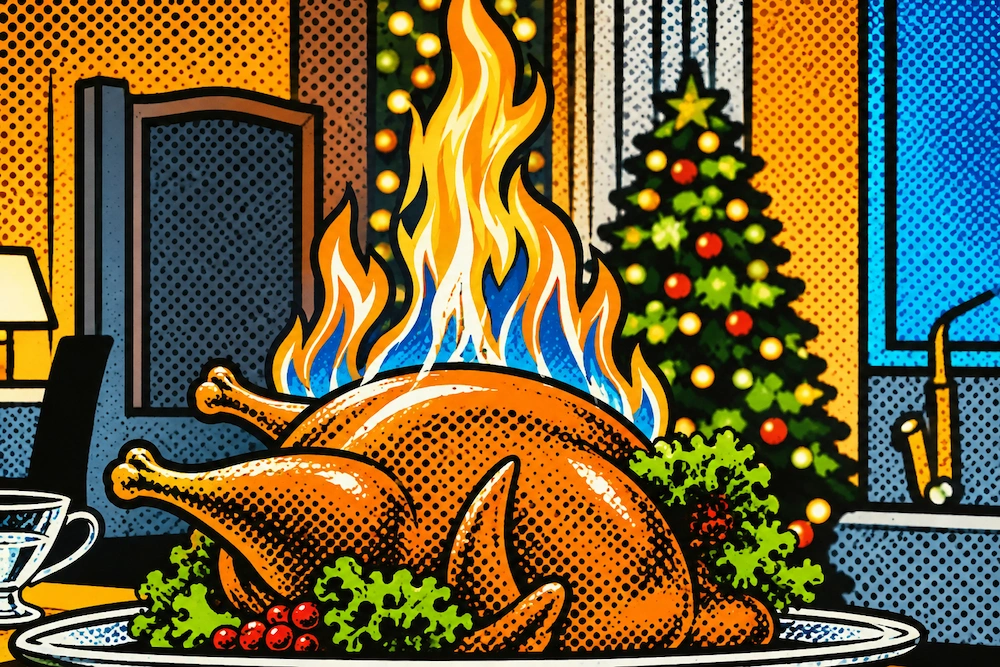
"Jason!" Josh cried, "Get the fire extinguisher!"
I slipped into the house, down the stairs to the basement, grabbed the extinguisher and, as I made my way back to the garage, made sure our mother didn’t catch sight of me.
My brother Josh, bless his heart, wanted to give our mother a Thanksgiving reprieve that year. He'd set up a deep fryer at the top of the driveway to cook a couple turkeys. The first bird still had some ice on it, though, and when Josh dropped it into the fryer, the oil erupted. I can still see that simmering oil slick spread slowly down the driveway toward a sizable patch of dry grass.
Still, Gen X rules of childhood prevailed. What the grownups don’t know can’t hurt us. We can fix nearly anything. And above all, DO NOT BURN THE HOUSE DOWN.
What happened next remains contested to this day.
For years, our extended family got together every November, and the elders shared holiday stories of yore. We all knew these stories, but each year they changed just a bit. An embellishment here. A nearly innocent exaggeration there. And, of course, any objections from the “kids”—read: everyone 40 years old and under—were drowned out by peals of laughter. And our Mom always got the last word.
Fortunately, when my brother nearly scorched the front lawn, no one was recording the moment. For that reprieve from the “archive fever” of our times, I’m eternally grateful.
Why should technology get an exemption from the privacy expectations we've established for human relationships?
Imagine, say, you get a new, recently divorced, next-door neighbor in October, and you find out he has no family in the area. Like a good neighbor, you invite him over for Thanksgiving. He arrives with his iPhone 18 in hand, and proceeds to record every embellished tale, every embarrassing admission. I later find out that he also slipped my cousin Timmy twenty bucks in exchange for everyone’s vCards. So their phone numbers, email and mailing addresses. The works.
So how might you react in that situation? What if you subsequently found out he was selling your family Thanksgiving dossier on ebay? Would you be tempted to hire my brother to set his front lawn on fire?
This situation is, of course, merely hypothetical. A hypothetical that disregards even the slackest notion of discretion.
At some point, it became “normal” to allow companies to collect and track our conversations, purchases, movements, and relationships. Sure, sometimes it serves legitimate purposes, even to our advantage. Today, big data just might be too big to be polite—which tech innovations do from time to time. Still:
Why should technology get an exemption from the privacy expectations we've established for human relationships?
2003 proved a pivotal year in terms of digital privacy. That spring, Ghyslain Raza became an international celebrity, as a matter of happenstance. That April, a high-school friend transferred a video of his improvisatory dance moves from analog to digital, and “the Star Wars Kid” was born. In a matter of months, the clip averaged more than 1 million views per day and, in turn, nearly ruined Raza’s life. Raza eventually earned a degree in law and, in 2013, re-entered public life to advocate against online bullying.
That summer, Americans started registering their telephone numbers on the country's new Do Not Call Registry. Within 12 months, Americans registered more than 62 million numbers. 2003 was also the birth year of LinkedIn and MySpace, and the year the creator of facemash.com faced disciplinary charges at Harvard for “breaching security, violating copyrights and violating individual privacy.”
“Issues about violating people’s privacy don’t seem to be surmountable,” wrote the defendant and eventual dropout. “I’m not willing to risk insulting anyone.” (So respectful!)
The privacy-be-damned business model, though, was at least four years old. In 1999, DoubleClick, the leading online advertising network, acquired - via Abacus Direct - five-year purchasing profiles of close to 88M US households. Once the plan to integrate offline activity with online behavior went public, the backlash proved fierce. But ultimately, short-lived.
In that single, pivotal year, then, Americans deemed sales calls at home too invasive, while select companies figured different rules would prevail online. In the early years, many of us wondered: What does LinkedIn actually do? Turns out the better question was: What were these new networks going to do with our data and attention?
As personal information became a commercial asset, its collection and retention became more inviting. And every new stockpile created another opportunity for things to go off the rails
In the last four years, we’ve seen Supreme Court justices get doxxed. The compromise of ancestry information, genetic relationships, and other personal details of nearly 7 million customers at 23andMe. (“Oh … I always thought Bobby looked a lot like Uncle Jim.”) And hundreds of millions of personal records exposed in a breach at National Public Data.
For founders and entrepreneurs, every name and email address, every slice of psychographic data, and every transaction record come with responsibilities. Somebody has to store it, secure it, and manage access to it. And, when things go wrong, someone has to explain what happened to customers just like us. When it comes to products and services, then, there’s a more fundamental question:
Does a company need our information to deliver the service, or does it need that information to support its business model?
For the next generation of Silicon Heartland founders, maybe there's a lesson here. What if we built tools to accomplish specific tasks, and captured only the information required to complete them? What if those tools worked so well that customers came back willingly? That they recommended them to their friends? That we spared ourselves the trouble of sending increasingly intrusive emails, ads, and texts begging for a reply?
Imagine a business model focused on earning people's devotion, rather than pilfering their personal data.
Sounds a bit like the family stories we pass around the Thanksgiving table. A thing worth remembering, sharing, and revisiting. Like a more social and pleasurable type of consent for cookies (and cakes and pies).
For the sake of the season, we put our devices aside and uncork an immodest tally of wine bottles. A glass or two in, we recall outrageous holiday moments, and live in the moment long enough to create a few more.
Thank goodness for “analog Thanksgivings.” I mean: had someone whipped out their phone at the first sign of tomfoolery, I'm sure we'd have had fewer outrageous stories, fewer embarrassing admissions, and considerably better-behaved relatives. What a loss.
Left to our own (ahem) devices, we produced moments that we’d recall the next time we got together (and the time after that). Over the years, those stories became part of our collective memory, an imperfect analog archive that gave us one more reason to be grateful.
Today, we may record a quick video or two to share with family members who couldn’t make it. Otherwise, we resist the temptation to extract ourselves from the action to record, archive, and—all too often—never replay the moment.
Perhaps there's something sacred about those moments we choose to keep to ourselves.
And violating that sacred bond? It’s just bad manners.
Jace Martin is a Columbus native and the CEO of employee-owned dSaaS. He has spent more than 30 years working across technology, infrastructure, media, and startups. Jace writes about the history, economics, and occasionally strange decisions that shape how technology gets built in the Midwest.