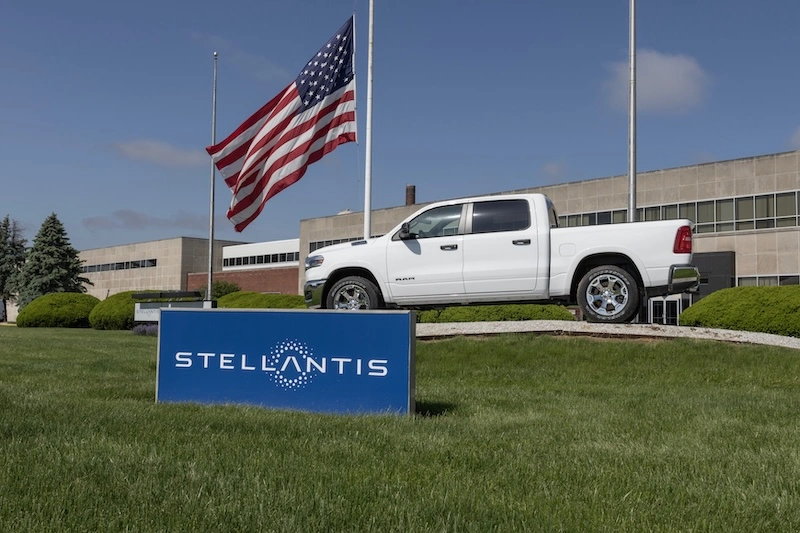
Automotive conglomerate Stellantis, home to brands including Jeep, Dodge and Chrysler amongst others, plans to spend $13 billion over four years to boost production across Illinois, Ohio, Michigan and Indiana. The automaker says in a statement announcing the investment that this will add more than 5,000 jobs and lift output by roughly 50% at several of its plants. The move solidifies a long-term commitment to building both electrified and efficient combustion vehicles in the Great Lakes region.
The plan includes reopening a plant in Belvidere, Illinois, to expand Jeep Cherokee and Compass production; launching an all-new midsize pickup in Toledo, Ohio; extending SUV programs in metro Detroit and Warren, Michigan; and adding a new four-cylinder GMET4 EVO engine line in Kokomo, Indiana, beginning in 2026. Specific model timelines vary by site, but Stellantis frames the overall program as a multi-year build-out tied to U.S. market demand.
The scale of the investment is likely to reverberate through the supply base. Electric and hybrid platforms require large volumes of motors, inverters and permanent magnets - components where domestic capacity has been lagging. The Stellantis plan, if executed on schedule, may provide a clearer runway for suppliers.
One of those suppliers-in-waiting is Niron Magnetics, a Minneapolis company developing rare-earth-free permanent magnets based on iron and nitrogen. The technology originated at the University of Minnesota in the lab of professor Jian-Ping Wang, who co-founded the company; Niron has since scaled to about 125 employees in Minneapolis after a 2024 facility expansion.
On Sept. 26, Niron broke ground on a 190,000-square-foot plant in Sartell, Minnesota, designed for mass production starting in 2027. The company says the facility will create more than 175 full-time jobs. Niron is also collaborating with Stellantis on next-generation electric motor designs, an R&D effort supported by the U.S. Department of Energy alongside national-lab and academic partners.
While the automaker’s investment does not guarantee sourcing decisions, the parallel timelines highlight an emerging storyline: Midwest university-born materials science maturing into regional manufacturing just as large vehicle programs ramp nearby.
Today, most rare-earth magnet production is concentrated in China, creating a chokepoint for Western manufacturers. Niron’s iron-nitride approach aims to deliver comparable performance without rare earths, but it must prove repeatability, cost and throughput at commercial scale. Automotive validation - particularly for traction motors - typically spans multiple test gates and model cycles.
Stellantis’ manufacturing slate is the immediate headline for the Midwest, anchoring jobs and volumes across four states. Running alongside it is a Minnesota-created magnet technology that, if it clears scale-up and validation, could localize a critical EV component in the same region where the cars are built.