
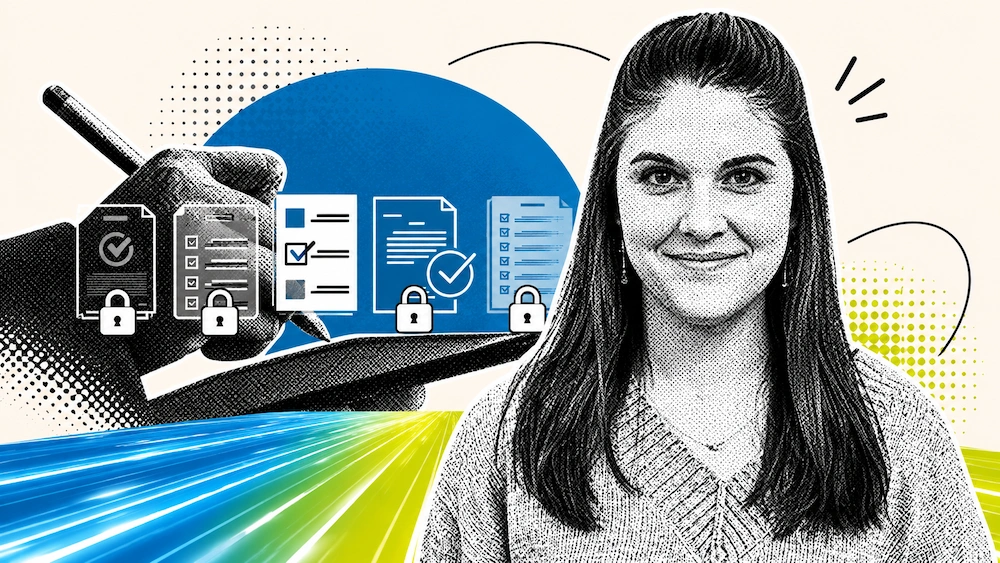
Rehgan Bleile co-founded AlignAI, a Columbus, Ohio-based AI governance company, in 2021. She and co-founder Brendan Kelly bootstrapped the company, paused when ChatGPT reshaped the market, and now sit on the upstream side of AI governance: capturing what an AI system is meant to do before anyone tries to enforce it. We talked about the origin story and her advice for building in the Midwest.
What were you doing before AlignAI, and what made you start an AI governance company?
There were two distinct moments. My co-founder and I worked at a previous startup solving problems in machine learning operations, and that's where we had the idea and the premise for AlignAI. That was probably around 2018.
We were taking machine learning systems into production and helping organizations with compliance and monitoring. We worked with massive, top-10 banks, along with insurance companies and manufacturers. All the technical problems were pretty solvable, and we had really elegant solutions. Brendan and I were solutions architects and product managers, so we spent a lot of our time getting those solutions out there. But the biggest challenge was that we constantly had to jump through hoops around governance and compliance. I tried to understand why that was such a big problem, and there was also a lot of resistance. We worked with people on the trade floor who were highly resistant to using algorithms to make trades. They know their data best, and they don't want to rely on a system some data scientists built. So we saw the early inklings of some core, fundamental problems we were interested in solving.
We recognized it was a collaboration problem. Risk and compliance had checklists of things they needed done that you never found out about until you were trying to go live. You had people highly resistant to depending on a system for a critical operation, and then all this technical nuance on top. We asked, “What if you did all of that hard work upfront?” It's a constraint problem. You have people who are worried, so what are your worries, how do we prevent that, and how do we provide transparency? Same for governance teams. We had the idea then, and we said that if we ever went off to do our own thing, that's what we would try to solve.
We stuck around a bit longer. Eventually I wanted to pursue a different opportunity, so I started at a local startup in Columbus as head of solutions. I wasn't quite ready to make the full leap into entrepreneurship. It ended up not being a great fit for a lot of reasons, and I was only there for a few months. That was the moment that tipped me over the edge. So I said, why not? Let's go out on our own. My co-founder was still at our previous company, so at first I took the leap a little bit on my own.
My last day at that company was the day everyone got sent home for COVID. I'd put in my two weeks' notice beforehand with no idea a pandemic was coming. I think it was Friday the 13th in March, just to make it a good time. I waited it out for about six months and did some work on the side to keep myself afloat. Then I finally convinced Brendan to leave his company and join me, and we launched AlignAI in 2021.
A year and a half later, ChatGPT dropped and the whole ecosystem around AI exploded. So talk about good timing.
In plain terms, what is AI governance, and what problem does AlignAI solve?
It's the lack of alignment on intent for AI systems, or intelligent systems, and navigating all the constraints. When you hear "AI governance," there are two sides. One is what the system should and shouldn't do, can or can’t do, and the other is how we enforce that.
We don't really sit on the enforcement side, although we do handoffs and validations there. Gateways, guardrails, and all of that is the enforcement layer. We sit upstream of it. We build what we call a blueprint of the AI system: What data does it touch? What systems? Which decisions? What technology is it using, and how is it using the data? If it's a vendor solution, where is it hosted? It's every single detail about the system.
We can run risk evaluations against that blueprint, help people be more preventative about the governance controls they need to implement, and provide very clear guidance on appropriate use for that system.
What was the hardest early decision you made as a startup founder?
The hardest was deciding to pause when ChatGPT dropped. We had a first version of our product ready to go. Generative AI wasn't a new concept at the time, but we didn't anticipate it breaking through into the mainstream conversation. That meant the intelligent systems we were looking at were changing rapidly. We asked ourselves whether this changed the way we build our product, and the complexity of the problems we were addressing. So we paused to see how the market would react.
It was a tough call because we had a lot of momentum. We'd been working on the company for two years, and we needed to step back for a second. It turned out to be a really good call. We made a couple of fundamental pivots because of it, and they were good ones. Not against the problem we were solving, but in how we were solving it. We had been trying to solve the problem from the people side first, which was more knowledge-based. We moved toward capturing context from the systems themselves.
It ended up great, but it was terrifying because we were bootstrapped at the time.
How has building a startup in the Midwest influenced the growth and trajectory of the company?
There are pros and cons to everything. One of the big pros is that I've been building a data and AI community in Columbus for over a decade. Being able to navigate the Ohio ecosystem has been incredibly beneficial. A lot of our first customers are based here, and selling in this space is all based on trust, so long-term relationships help. That's hard to do in other communities.
We focus on industry verticals like insurance and banking, and the Midwest is great for that. We're a global company, and my co-founder lives in Spain, but we have good talent here in Ohio, too. We ran a national search for our founding engineer, and it just so happened he lived in Columbus. It wasn't even a requirement.
The cons are the ones everybody else talks about. You just don't see a lot of horizontal enterprise technology being built here. It's mostly highly verticalized: biotech, insurance tech. That makes sense, because those industries are here. But it means fundraising takes a bit more education about our space.
What's one thing you got wrong early on, and what did it teach you?
Brendan and I are both career startup people. We've worked at startups our whole careers, and we've watched a lot of companies do things well and not so well. We're also both systems engineers by trade, and our first hire was a systems engineer, too. So we over-processed things in the beginning because we were so driven by efficiency. You just can't do that early on. You have to be messy and rapidly experiment. There should be some rhyme and reason to it, and you want to stay efficient, but if you overdo it, you're too constrained. I would have done that a little less.
It serves us well now. We don't need to hire as much headcount, we use a lot of AI internally, and we've been incredibly efficient building things for ourselves. But early on, it was over-processing.
What does a day look like today versus a year or two ago?
I used to be incredibly involved in all of our implementations and customer calls, very much in the weeds. I'm not out of that entirely, but a lot more of my time has shifted to the sales and marketing side. When you're early, you're still learning and validating exactly what you're building. Once you have a good foundation and you're seeing repeatability, you start to shift more toward sales and go-to-market. The whole market is always shifting, so I have to keep a really detailed pulse on it.
For the company, we're in our groove. Two years ago we were still asking whether to go this way or that, and how to get more data points to figure it out. Now we're confident in the direction, and we're seeing a lot of repeatability. The decisions are smaller, like whether to enter a certain technical territory, rather than who we're targeting and why. That has solidified, and it feels really great. The team is about 15 people, all in.
What's next for the coming year?
I think this is going to be a big growth year for us. I had the idea in 2018, really got my start in 2021, and then everything changed in 2022. The problem we're solving is around governing, so you have to have things to govern before people feel the pressure and the pain. We knew it was coming, but companies don't act until they feel extreme pain or external pressure.
That pain has been increasing. People are talking about it, budgets are starting to solidify, and early adopters are ready to pull the trigger. I don't even need to convince anybody anymore that governance is top of mind. The market has caught up, which is a wild time to be in. We still have strong opinions about how to approach it that we need to educate people on, but they no longer need to be convinced that they need it. I believe a recent Gartner report of 2,000 CIOs and tech executives said 71% said they plan to deploy agentic AI in the next 12 months, but only 21% had governance capabilities in place.
When the market heats up, competition does too, because people see the opportunity. We've been able to differentiate in two ways. First, we have a level of trust in the market because we've been at this for so long. We're not random newcomers wedging into a space because of the opportunity right now, and that goes a long way in the sales process, especially in financial services and other high-risk environments. Second, our philosophy on the governance ecosystem and how much time we spend on the intent side gives us an edge.
The real crowdedness is in enforcement. I don't want to say it's the easier problem, but it's more cut and dry. You're dealing less with people and more with controlling the technology. I'm not saying it's easy, but capturing nuance and context from people is a really hard thing to do. It's a very complex ecosystem that's getting crowded and intense, and the regulatory changes create a moving target for what the rules should be. So it's crescendoing this next year.
How do you capture that context? What does it look like when you start with a customer?
There are a lot of different ways, and we explore every way we can to get the correct information. The standard today is that companies put together questionnaires of 25 to 80 questions that people just fill out. The result is highly incomplete, with terrible data quality. You're asking a non-technical operational leader about PII and regulatory triggers, or how they plan to implement “human-in-the- loop.” They don't know the answers. So they either make it up, don't answer, or give up on the process and find another way, which is not great either.
That's the crux of the problem we're trying to solve. We infer information from tons of different systems, which is incredibly hard, and then we validate and reconcile it. We also translate questions for individuals. Instead of saying "PII," we ask whether they're using emails or names, something they understand. And we make sure questions are routed to the right people. Of those 80 questions, maybe four are relevant to the person filling it out. The rest become relevant once they have context about what they're trying to accomplish.
Once you have all of that information, what you do with it and how you evaluate it becomes really useful. That's our AI blueprint.
What does the process look like from a customer's first day through full implementation?
A lot of people choose us because we have both the technology and the expertise. On day one we want to understand their operating model deeply: who does what and when, what the handoffs are, what systems they use today. Then we help architect the change, because that change is not small.
We get them onboarded and initialized in the product very quickly, in a matter of weeks, which for a large regulated enterprise is a whole thing. From there, you bite off different parts of the ecosystem piece by piece. Some organizations start with risk evaluations and approvals. Some start with the dynamic intake I described. Some start with a portfolio view of everything they have across the company. Eventually we get them onto the entire ecosystem.
We onboard everything and set it up quickly, and then it's a drip process as they go live. Since we have to be highly integrated into their ecosystem, we spend time helping them get those integrations live as well.
What advice would you give another Midwest founder building in this space?
In this day and age, you really do need expertise in some area. Brendan and I spent a number of years in financial services and governance, so those two things made sense for us. You could probably start a company in a space that's newer to you, but it's important to lay a foundation of knowledge somewhere and then build on top of that. I see a lot of people trying to be opportunistic and launch something in a particular space. It will be incredibly rare for someone to find success that way. More and more, people want domain expertise in whatever it is you're building.
If you know a Midwest founder we should profile as part of this interview series - or you’d like us to interview you, go ahead and fill in our form here.
Aria Spears currently leads operations at an AI workflow redesign firm that works with Fortune 500 companies. She is a 50+ published writer and operator with ten years of experience building systems that create trust on teams. She builds it, then writes about it.