Adam Koopersmith first came to Detroit for Renaissance Venture Capital's UnDemo Day in October 2025. Six days after this year's edition, the Chicago marketplace fund he runs with Sonia Nagar, SNAK Venture Partners, announced it had led a $3.6 million seed round for Bloom, a Detroit marketplace that matches hardware companies with U.S. manufacturers. Bloom is the seventh investment from SNAK's first fund, and its first in Detroit.
Are the two events linked?
We’d imagine that SNAK had been in conversations with Bloom for some time, and that the timing was serendipitous, for us as well as those involved in the deal. That’s because it’s precisely the kind of outcome the event would hope to produce more frequently.
The Ann Arbor-based Fund of Funds held its 11th edition of UnDemo Day on Thursday, October 1, at The Department at Hudson's in downtown Detroit, the second time we’ve been in the building for a startup event we've covered, after the Red Bull Basement National Final in May.
This time however, there were three events at once. Venture Forward - founded by the National Venture Capital Association (NVCA) to “accelerate the success of VC investors across the country,” according to its own website - ran its Emerging Manager Office Hours in the morning, UnDemo Day's founder and investor meetings filled the afternoon, and the final semifinal of the state's PitchMI competition also took place under the same roof. Combined, the events led us to wonder whether Detroit has ever packed this much of its ecosystem into any single day, ever.
How UnDemo Day's ‘fantasy draft’ works
UnDemo Day works similarly to a ‘fantasy draft’, as Renaissance CEO and Managing Partner Chris Rizik told us back in July. Startups apply, investors review the roster weeks in advance and pick who they want to meet and "vote with their draft choices", in Rizik’s words. The most-requested companies get a table for a set schedule of 20-minute meetings throughout the afternoon.
"2026 brought a record number of startup applications (270) and a record registration (850). We had to shut down registration more than a week before the event," Christina Drake, Partner at Renaissance, told us. More than 100 investors traveled from across Michigan as well as from out of state, with investors visiting from 16 states in all. "I care about the numbers because they create the density required to get people excited about building and investing in Michigan, and to get deals done," Drake added.
For founders, the opt-in format is what hopefully makes the day more useful than other, similar formats.
Josh Ross, CEO and co-founder of Grand Rapids-based Scaleable AI, which builds AI agents for manufacturers, was a first-timer. "Every conversation started warm," he said. "We had six 1:1s plus three [additional] intros from the Renaissance team, and all but one have already turned into follow-up meetings." He estimates that without the event, reaching that many Midwest funds "would take months of cold outreach and warm intros, and we got it [all] in one afternoon."
Shane Emmons, founder and CEO of Saginaw's Swept AI, which secures AI systems for mutual insurance carriers, came hoping for one or two good conversations and was more effusive in his feedback. "Not being a Stanford dropout that went through YC, it can be hard to create connections with investors," he said. "We have to play six-degrees-of-Kevin-Bacon when [we] try to meet investors, even in our region. With UnDemo day, I felt like we were given top billing … we had a rare, unfair advantage."
Repeat participants, those who’ve felt that ‘unfair advantage’ before, backed this up.
Mike Klein, CEO of Ann Arbor's Genomenon, described the format as "two hours of speed dating" and called this year's edition "the best … so far" while Nishant Dixit, founder of Detroit's Alisio, which builds infrastructure for manufacturing finance, says that without the event Alisio "would spend a significant portion of our bootstrapped capital traveling just to secure first round meetings with institutional investors."
Dixit has seen how the invisible barriers to these connections can play out. They were the recipient of eLab Ventures’ $50,000 SAFE check at ClawCon Michigan earlier this year, which was judged entirely by AI. eLab’s Managing Director, Doug Neal, admitted in a LinkedIn article after that event that the fund had previously passed on Alisio. However, based on the structured company data each company submitted to eLab, AI did the diligence and chose Alisio as the best fit. It is a solution that may be adopted more frequently in the future, being perhaps a leveler; one that the region may need. "I still believe Midwest VCs need to lead more first checks and streamline the compliance burden for early capital," Dixit added.
The investors who came to look deeper into Michigan
Dixit also shared a story that partially explains why it matters when outside investors actually do spend time visiting our local ecosystems. Last year, he told us, he was on a call with a west coast investor who when they heard he was based in Detroit, gave a dismissive remark about the city. Dixit's reply was simple: "When was the last time you were actually here?"
Steve Kiser has taken that literally.
The General Partner at San Diego's Veteran Ventures Capital, which invests in dual-use hard tech, arrived in Detroit the weekend before UnDemo Day and spent Monday through Wednesday prior to the event visiting founders. He admits he arrived with "the (mistaken) impression that Detroit was mostly transportation tech and fintech," and instead found companies in all six of the dual-use verticals his fund invests in.
"Seeing a pitch deck is one thing, and we see about 50 a month," Kiser told us. "Walking a production floor, hearing the sounds of machines making things, seeing the movement of people and raw materials moving through a process, and holding the end product in your hands is a completely different experience," he said, adding that his fund met three companies with which they are "in early due diligence."
Kiser wasn't the only one to mention the city's history.
Troy Morris, CEO and co-founder of KMI Space from Marquette, Michigan, which offers relocation as a service for satellites, has been taking part in UnDemo Day since just after the pandemic. The event, he said, "helped reshape the perspective that Michigan is where we're making things again, not just where the Arsenal of Democracy [is an] historical artifact."
That’s also a trend visible in registrations. "The number of participating investors who are focused on industrial sectors like manufacturing, advanced materials, mobility, and energy grew substantially this year, matching a trend we're seeing with lots of interest and investment dollars flowing into AI for the physical world," Drake said. "This is where Michigan, given our legacy industries and immense engineering talent, has a right to win." That trend is also visible in other parts of the country, with the firm that coined the term “software is eating the world,” west coast behemoth Andreessen Horowitz, recently announcing a $1.1B fund for AI hardware they’re calling the ‘Machine Age Fund’.
Many of the startups present at UnDemo Day bore that trend out: Alisio and Scaleable AI both apply AI to manufacturing, while Detroit's Layer1Labs, represented by co-founder and CEO Ryan Anderson, is developing technology for next-generation AI infrastructure.
Venture Forward brings Emerging Manager Office Hours to Detroit
Earlier that morning, Hudson's belonged to investors who are earlier in their careers.
Venture Forward, the nonprofit arm of the National Venture Capital Association (NVCA), has run 16 Emerging Manager Office Hours (EMOH) programs since 2018, and this Detroit edition was the first to take place in the Midwest since Chicago hosted in May 2022. Renaissance CEO and founder Chris Rizik - who sits on Venture Forward's board - told us back in July how he pushed to bring it to the Motor City.
"One of Venture Forward's priorities is to expand access to the VC industry beyond traditional hubs like Silicon Valley, New York, and Boston," Maryam Haque, Venture Forward's executive director, told us. The session connected 25 emerging fund managers, 64% of them based in the Midwest, with 11 office hour hosts for 100 curated meetings. The hosts represented some of Michigan's largest VC funds, including Arboretum Ventures, and institutional allocators including GM, the University of Michigan endowment, and the State of Michigan Retirement System.
Koopersmith was one of the 25. SNAK is still on its first fund and expects to raise a second "likely in early 2028," and what he says he valued most was candor. "It can often be difficult to get candid [with] potential investors during the fundraising process," he said. "The folks participating in EMOH were very upfront … with respect to what they like and don't like in terms of relationship development, interim Fund updates, in person meetings, etc."
Nia Batts, Managing Director at Union Heritage in Detroit, added that meeting fellow emerging managers “reinforced the importance of collaboration” in their work. “We need to continue building our regional networks and sharing early-stage dealflow so we can support founders at critical inflection points and work to keep their companies in the Midwest as they scale,” she said.
Haque also gave her take on how sessions like EMOH can benefit the capital-allocation side of an ecosystem. "One area that I think deserves more attention is supporting local emerging VC fund managers. We often talk about how to attract more investment for startups, but it's equally important to develop the next generation of investors who will discover, fund, and champion those companies who need capital and mentorship throughout their lifecycle," she said. "A stronger local VC ecosystem can create a more sustainable pipeline of capital and support for Michigan founders."
PitchMI's final semifinal, and a long week on the road
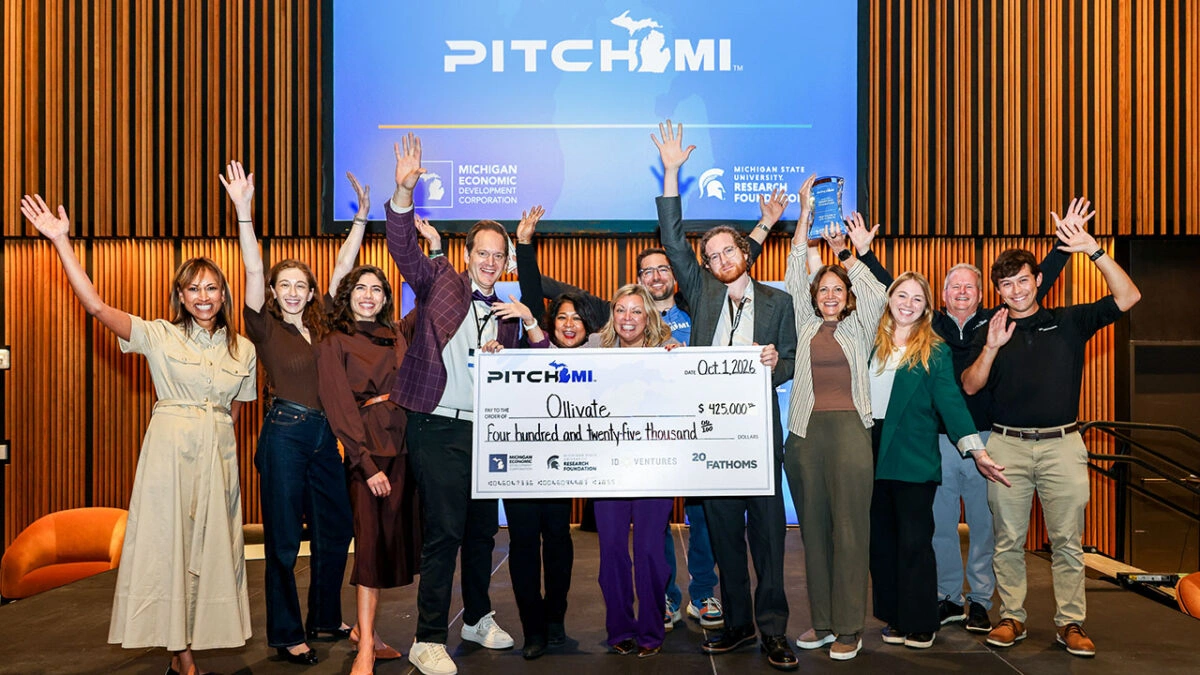
The final event of the day at Hudson's on October 1st was the fourth and final PitchMI semifinal, on this occasion featuring Healthcare and Life Sciences companies, and the winner was Detroit's Ollivate, a gamified, mobile-first learning platform for nurses preparing for board exams and continuing education. They won $425,000, with a $375,000 semifinal prize, backed by state funding and with co-investment from Anchor Up Ventures, Kalamazoo Forward Ventures, JM Longyear, and ID Ventures with an additional $50,000 from Traverse City fund 20Fathoms in Detroit completing the $425,000. Authsnap, PathwaysGI, TruVue, and Signal Bioscience were the other businesses pitching at this semifinal.
"This will allow us to put money back into the Michigan market, so we can hire people and do things here in Michigan and give back to the community," Ollivate co-founder and CEO Josh Olson said in the MSU Research Foundation's announcement following their semifinal.
Ollivate will join Motmot, Common Vector Robotics, and OmegaCool in the statewide championship Final in the spring of 2027, where one of these Michigan companies will be provided with an additional $1 million. PitchMI has awarded $1.7 million across the four semifinals so far this year, although, as we noted back in July, the competition is not yet guaranteed to continue beyond this current cycle.
UnDemo Day also sat in the middle of an intense couple of weeks of ecosystem events across the Midwest. Tech Week Grand Rapids took place the week before, JumpStart's VC Fest in Cleveland finished the day before, and StartupCincy Week kicked off a few days later. Founders and funders actually traveling to take part in events between Grand Rapids, Cleveland, Detroit and Cincinnati in the space of just a couple of weeks is what a connected Midwest ecosystem can hopefully continue to look like. The density of each location is rarely enough, but coordination between them can help correct that.