
Become a member & keep reading for free, or choose a paid membership.
Access all our content & email newsletter
It is human nature to be curious. To be imaginative. To create things, concepts, and structures. To wonder about the world around us and the way that it works. To build. To break things. To deconstruct and rebuild. We were designed to want to know why things are the way they are. We were meant to never stop searching for answers, never stop challenging norms, and never stop finding our own way forward.
These inherent and fundamental aspects of human nature are ultimately what led to all great inventions and innovations, including artificial intelligence. Lately, I’ve been wondering a lot about what led to the development and proliferation of AI. It’s crazy to me that the field of AI research dates back all the way to 1956. I am massively oversimplifying this, but it took decades upon decades of research, thinking, and developing, as well as several AI winters and many funding fits and starts to arrive at the point of widespread application of machine learning in the 2000s. This ultimately gave way to the public use of AI that is impacting the world of investing, startups, software, and entrepreneurship in such a monumental way today.
Tough Questions About AI, Innovation, and Humanity’s Sense of Wonder
A few weeks ago I watched the film The AI Doc: Or How I Became an Apocaloptimist, which was released in late March. The primary point of conflict in the film is the crippling and paralyzing fear about the existential risks of AI as artificial intelligence reaches its maximum potential. Yet at the same time, the private and public benefits of AI are endless and if used correctly, could improve societal outcomes and make the world a better place.
This film left me wondering about several somewhat existential questions related to AI:
Did anyone ever pause and ask why we are building this and is it the right thing to do?
How do we make sure it doesn’t get out of control?
Should innovators have a moral obligation to ensure that what they build will have a positive impact on society?
How do we leverage and manipulate AI in such a way that it doesn’t squash humanity’s inherent creativity, cognitive thinking, and sense of wonder?
All that being said, isn’t AI also one of the most creative and wondrous things human civilization has ever created?
Metrics Don’t Tell the Whole Story: What We’re Backing When We Write a Check
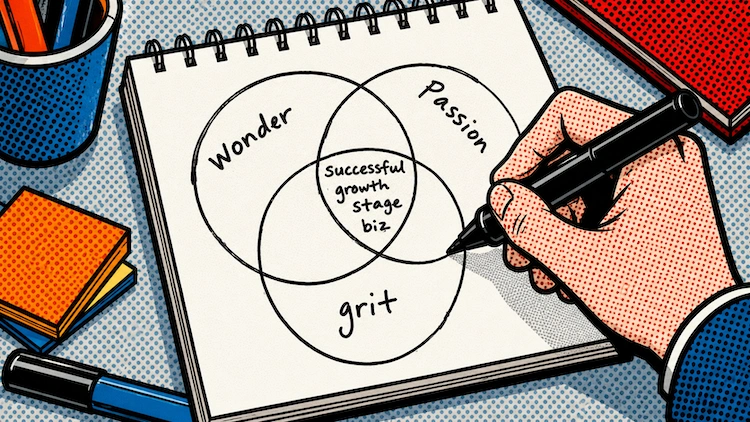
While we’re deep in the doom and gloom of SaaSpocalypse (also known as the significant public valuation multiple suppression of the current era, or the market correction/repricing of public software companies… neither of which is as sexy a title), I’m still holding out hope as an optimist. The reason for this optimism? I don’t believe that AI can replicate and replace the wonder, passion, and grit that runs through the bloodstreams of the CEOs that our firm, Straylight, backs.
Yes, I know that sounds cheesy, but when I take a step back and think about the common thread between our most successful CEOs, it is those intangible characteristics that our CEOs and Management teams have in common, and I believe those are the qualities that drive successful outcomes.
A few months ago, we had one of those Management teams presenting to our investment committee (IC). Prior to the meeting, we had gotten to know this company over several weeks, reviewed an initial data room and financials, and prepared an internal IC Summary for the team.
With that in mind, I have to say that this was one of the most compelling, interesting and engaging IC presentations I’ve witnessed over the past four years at Straylight. The founders had so much passion for the business they were building, it was striking. It made me think about this concept of “funding wonder” and how this sense of wonder is necessary in order to come up with new business concepts.
We invest in companies that have solidly achieved product-market fit, which we believe to be around $3MM in annual recurring revenue. So we’re not funding just wonder, we need to believe in the reliability of the revenue, that future growth forecasts will be achieved because of historical growth proof points, and there has to be overall fit relating to gross margins, unit economics, and capital efficiency. But I love the idea that at the end of the day, we as investors are funding - and ultimately generating a return for our LPs based on - this concept of wonder.
This management team and business model couldn’t be more different than a more recent investment we closed about two weeks ago (and are excited to announce hopefully next week). But undoubtedly the two CEOs have this sense of wonder, an immense amount of passion for the work they do, and a boat load of grit and resilience in common.
Three Qualities No AI Can Replicate (Yet)
These qualities of wonder, passion, and grit can take many forms:
If the concept of wonder is too cheesy for you, perhaps creativity or curiosity is more relatable; in order to build a business, found a startup, and create something from nothing, there has to be a good amount of creativity. A few months ago I wrote a piece about creativity in the boardroom, in which I stated that creativity is the reason entrepreneurs – and the companies we invest in – even exist.
Founders are some of the most passionate people I know, and often, the more passion they have for their company/product/value proposition/industry, the better. Early stage companies often sell products and close deals because of the passion of the founder. What inevitably gets very challenging though is how to scale and repeat that passion-led sales motion? I’ll throw in a shameless plug here for a capital partner like us at Straylight: we have a Value Creation team and bench of operating partners with many reps and a lot of experience scaling past founder-led sales. I think that a founding team’s passion can get them very far, even in the age of AI, with the asterisk that you can’t have passion alone. But if you have passion and good performance (revenue, renewing customers, and a differentiated product that can’t easily be replicated by AI agents), then you’re in a really good position to endure this AI boom.
I feel like I talk a lot about grit or resilience in my pieces for StartMidwest, but it’s because it feels like a very important - but often overlooked- quality of so many successful founders in the Midwest. In our region, founders don’t give up when the going gets tough. There’s more of a cadence of work hard, keep your head down, and persevere than the Silicon Valley notion of ‘move fast and break things’ … while spending a lot of money, i.e. the capital that your investors provided.
Still Betting On Humans
Straylight has always invested in vertical, B2B software and tech-enabled services companies, and we’re likely not changing our tune anytime soon. We aren’t rushing to jump on the AI train and we don’t have a thesis or sector focus specifically on AI companies. There’s a lot to unpack as for the reasons why, but it has to do with the gap between what we believe is a reasonable valuation for a software business and what the valuation expectations for an AI company are likely to be, what is likely to be a pretty nascent customer base that hasn’t proven out it’s worth in a strong 120%+ net revenue retention figure after going through a few cycles of renewals, and lastly the amount of capital and monthly cash burn that is likely required to support an AI company.
We intend to continue backing founders and management teams that build durable companies with wonder, passion, and grit. And this is because of what I’ve observed from our own portfolio of nearly 30 active investments. At the end of the day, what I’ve come to believe is that wonder itself can be a competitive moat, and a durable one at that. It can’t be generated by a prompt. It shows up in the way a founder lights up when they talk about their customers. It shows up in the decision they make about the future of their business when no one is watching. And it definitely shows up in an IC meeting in Ann Arbor when a management team talks about their product offering and makes everyone in the room lean in a little further.
This is what keeps me optimistic in this weird, ever-changing, moment in the history of technology and investing. The SaaSpocalypse will shake out, although I hear experts and other software investors say it may take a few quarters. AI hype will begin to normalize. And what will remain are the founders that stuck it through, the ones who had something to prove, something to scale, and enough wonder to keep on going when the going itself got tough.
Michelle Erikson is Vice President at Straylight Capital. Her role involves assessing the health and scalability of potential investments, and supporting the growth of portfolio companies. Prior to Plymouth, she led marketing for the University of Michigan’s Athletics Department and worked for a venture-backed sports accelerator. While not a Midwesterner by birth, she has adopted us lovingly as her home: she loves Euchre, the Upper Peninsula, and driving by corn fields on her commute.
Read more on this topic
All Rights Reserved
Copyright 2026 Zeroto7 LLC
Powered by: