
Become a member & keep reading for free, or choose a paid membership.
Access all our content & email newsletter
As part of our sponsorship of HackMI - an AI and open-source hackathon backed also by IBM and Google and run by Compass Detroit back in May - this publication was able to present a challenge for the convening participants. The challenge we set was to try and build something to close the local visibility gap: the maddening fact that a founder in this region can rarely find the grant, the incentive, the accelerator, the event or working space that would suit them, because most of it is scattered across a few dozen city and state portals and the odd independent resource, all of which don’t relate to each other. It’s also a problem this publication more or less exists to chip away at.
This issue is constant. In the past week alone, we’ve been contacted by one founder asking which co-working or accelerator was most appropriate for their type of business, and conducted an interview with another who had to move interstate at the behest of investors. Imagine a situation where a pre-revenue founder is able to search “I need a grant for a pre-revenue health startup in Madison, Wisconsin” and gets back ranked resource cards with fit scores, an explanation of why each matches, deadlines, and links to apply.
Founders are often having to ask themselves: why should they locate in one city or region vs another, what’s there that isn’t where they are already? Who can they talk to when they arrive for objective advice? Sure, you can Google it or ask Claude, but you’ll usually get back a pile of disconnected pieces and a vague sense that the real answer is somewhere else. I know someone who recently came back to the Midwest from a week in San Francisco, where they’d been hosting an event with local organizers. Despite a bumper registration list, about 25% of those who registered actually showed up, against an industry-standard of around 50% The reason? In San Francisco there are a thousand things happening for founders on any given night. We don’t have that problem around the Midwest. Our problem isn’t volume, it’s signal: finding the right input in a place that has less noise but not a map.
Solving the Visibility Problem
HackMI is the official hackathon of Michigan Tech Week, and according to its primary organizer, Compass Detroit Executive Director (and Chief Developer Advocate for IBM) Jenna Ritten, it exists to “close that gap, in real time and in person.” According to Ritten, the weekend had around 350+ participants, who for 48 hours straight worked on problems spanning manufacturing, mobility, agriculture, small business, and more. “These weren't toy problems,” she told us, “our sponsors defined real industry challenges tied to real Michigan pain points that are receiving real Michigan investment dollars now.”
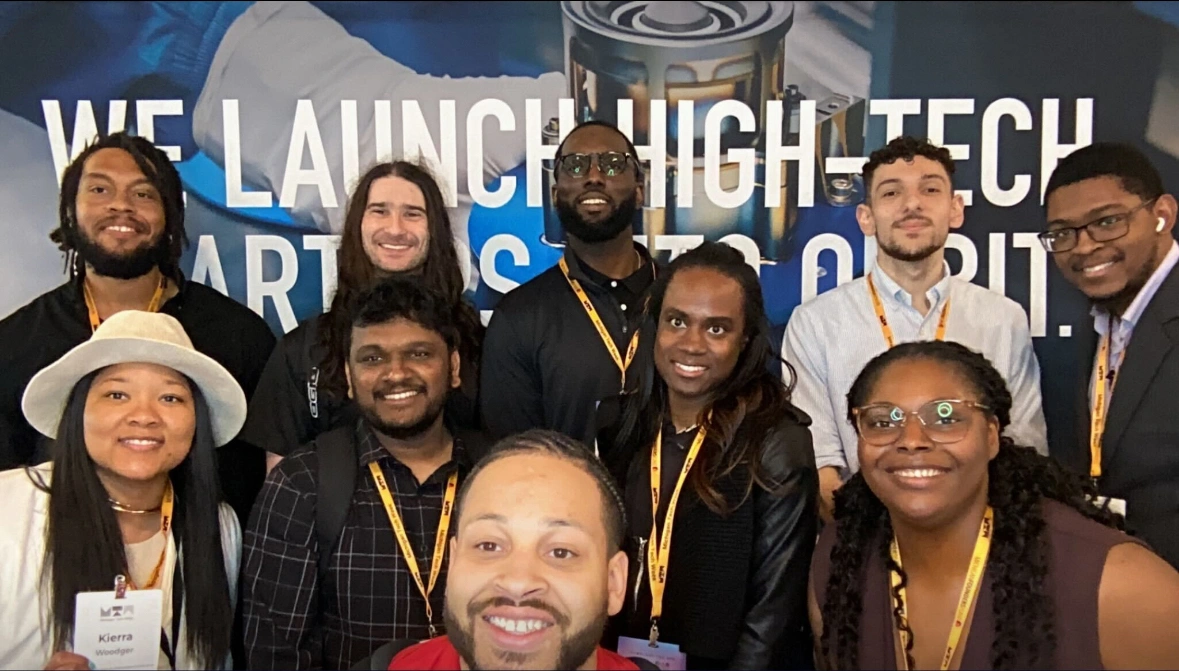
The team that ended up winning our challenge - with a plain-English resource-discovery engine for Midwest founders they called Trestle - had never met each other when they arrived for HackMI.
Jonah Yamine is a Senior in the software engineering program of The University of Michigan UM-Dearborn. He saw the hackathon posted in a school group chat and joined a pickup team. “I was looking to change careers,” he told me when I met with the group for an interview after the event. Part of their prize for winning our challenge is this story, to not only tell you more about them, but to highlight the issue further. Girardy Momplaisir is another member of the winning team. He’s an advanced performance integration engineer at GM with a master’s from Cornell who says he heard about HackMI through the National Society of Black Engineers, one of the event’s community partners, and came to see what he could produce in a compressed 48-hour window. The final member, Harshavardhan ‘Harsha’ Yaddalapuri, is the founding engineer at an early-stage AI startup. He studied in Illinois, and landed in Michigan last year. He found the event through the Google Developer Group of Detroit. For all of them, it was only their first or second hackathon ever.
It became clear in speaking with them that two of them had already lived the problem we were trying to solve with the challenge.
Harsha, who is building a pre-seed company, described leaning on his co-founder’s San Francisco network just to find people who could help them through the application process for Y Combinator - because there was no obvious local connection who could fill that knowledge gap. Girardy had hit the same wall at an earlier startup, where the founder was in Atlanta, the team was scattered, and the work of hunting down grants, research partners, and talent was, in his words, tedious and confusing. He put the deeper version of the problem better than we could when he suggested to us that it was about “how to leverage the connections I do make, instead of just connecting with everyone?” That’s the gap we were hoping to solve, and demonstrates how well this team has understood - and lived - the problem: it isn’t only that resources are hard to find, it’s that access without signal adds to all the noise.
“We wrote the StartMidwest AI Challenge "Innovation Ecosystem Discovery" around a specific frustration,” HackMI’s Jenna Ritten told us. “Michigan has real resources for founders, but they're scattered across city portals, state agencies, grant databases, and accelerator newsletters. It's one of the quiet reasons innovators end up leaving for the coasts, where your network does the work for you. Our founders shouldn't have to relocate to be taken seriously… or even just to find the support that already exists right here.”
Has AI made things easier?
All of the team described a shift in their belief in their own ability to build businesses in the current AI-moment. “I never had this idea of starting a business or being a founder. My goal was to find a job that pays well and grow in that direction,” said Harsha. What has changed is the ability to learn and the time required to do so. “I still remember I had 30, 40 Stack Overflow tabs open, going through each one and losing track of where I had found a solution,” he said. “Now with AI, it’s instant.” The distance between having an idea and having a working prototype has collapsed, and somewhere amongst that collapse he became someone who builds. He joined this hackathon - his first - because “I really couldn’t find the right person who has the same mindset as me.”
Jonah - who is currently hand-coding his way through school to ensure he learns the fundamentals properly - said the same tools had reshaped the field he’s trying to enter, and credited his two teammates with teaching him agentic engineering over the Hackathon weekend. Girardy, the most established of the three on paper, was also the most measured: AI, he said, has “helped what I actually want to do, my dream, come a little bit clearer and easier,” even as he said he’d prefer to keep the security of a job until he’s ready to fully commit to his own ideas.
None of these explanations means they have yet built a company over a single weekend: when we spoke, they were still pushing code, trying to get the current version of Trestle to be able to with an autonomous monitoring agent that could watch sources for new and dead listings.
The honest truth about most hackathon projects like this is that the majority of them stop the Monday after. A weekend MVP proves you can build, not necessarily that anyone needs what you built. That clearly wasn’t the case with this team.
But whatever Trestle becomes - and we do hope to create something with our readers via this site very soon - the people who showed up to fix the Midwest’s visibility problem just happen to look a lot like the answer to it, and they did it together over a weekend, having met on the first morning. That’s the true story of our current AI-moment, and helping make that happen is our mission, writ large.
Trending Stories
All Rights Reserved
Copyright 2026 Zeroto7 LLC
Powered by: