
Become a member & keep reading for free, or choose a paid membership.
Access all our content & email newsletter
.webp)
How does a Private Equity executive, at the top of his game and living on the east coast (was largely in Boston), end up creating an email newsletter business in Illinois?
“Life is short, have some fun,” Tim Huelskamp of 1440 tells me in response to an unrelated question about work culture. “That's a big one I've learned,” he adds, warming to his theme. “A lot of these founders, they'll be on their deathbeds and they'll be like, ‘I just worked my whole life and I actually didn't have any fun.’ If I could give one piece of advice [to other founders]: it's have some fun while you're building the company.”
1440 began back in 2017, when Tim and his co-founder Andrew Steigerwald sent the first email to 78 people on what may best be termed a hunch. “Everything is very nichey and verticalized and we said … curious people actually want to learn a little bit about everything and we couldn't find a product that served that curious audience.”
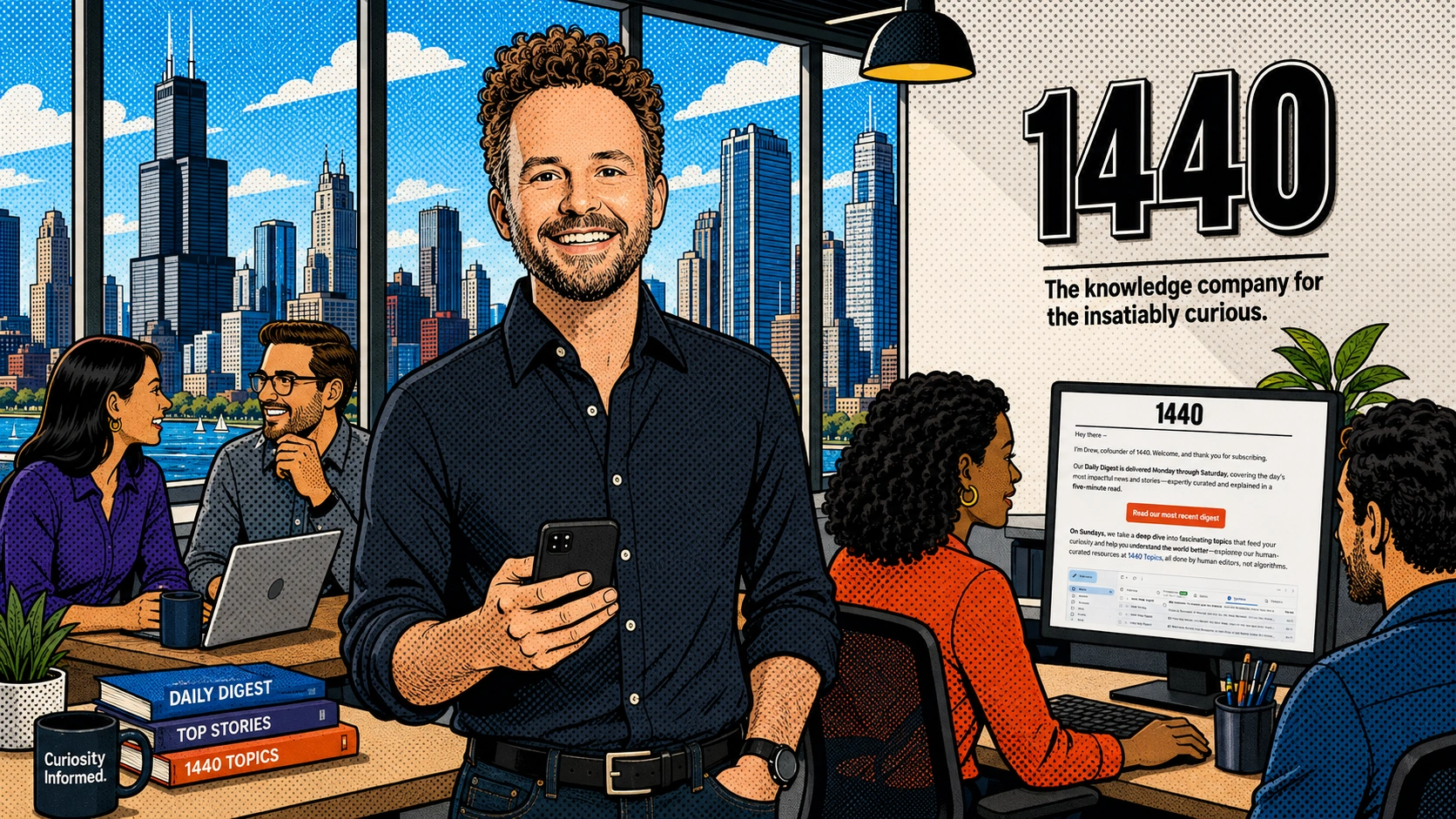
Today, that ‘newsletter’ business is read by nearly 5 million people and was recently valued at $101 million.
You say pop, I say soda.
Huelskamp grew up in Barrington, Illinois, in the suburbs of Chicago and says he has been a founder his whole life.
To demonstrate, he describes having a “pop stand,” selling sodas at the end of his parent’s driveway when he was only six. Later, he was burning CD’s for money in high school. “I had, you know, 200 songs or something like that on a piece of paper … in 1997 … like Tupac and Dave Matthews Band, and I would just give you a piece of paper and it was 10 bucks and you would circle 15 songs and I would print a CD for you.”
After high school, Huelskamp studied at Boston College's business school where he graduated during a period when "investment banking was [kind of like] the hot thing to do." He took a job at Jefferies, an investment bank, where he says he "slept under my desk," before moving into private equity at American Capital, a publicly traded fund of approximately $20 billion, and joined their late-stage growth equity tech team.
What 300 different companies taught the future founder
In Huelskamp’s telling, his decade in private equity gave him the analytical toolkit which helped him build everything since: unit economics, business models, why companies are worth billions or not and how they scale. But the experience that most likely turned him into the founder he is now came when he moved from the tech team to the firm's ‘operations workout’ team: the group that parachuted into struggling portfolio companies to help fix them.
He says the firm had roughly 300 portfolio companies at the time, and the failure pattern he noticed was almost alarming in its consistency.
"We would see … a dictatorial CEO who surrounds himself with B or C players, largely because he likes yes-men around him," he says. "The other 300 employees basically have all these great ideas, but they're afraid and they're walking on eggshells."
He says the firm ran post-mortem analysis across a couple hundred investments to find the biggest driver of enterprise value appreciation. "It was always the companies that had the best founders and management teams," Huelskamp says. "The biggest thing I learned there was [that] it's all about the team."
He carried that conclusion straight into 1440's hiring, where he still meets every person the company brings on and screens all new hires for three things: passion for the work, brilliance - but not ‘credentials’ he is quick to point out - and culture fit.
78 email addresses and a lotta white space
The idea for 1440 came from a shared frustration.
Steigerwald is a PhD scientist who once worked on Capitol Hill, distilling dense science documents for members of Congress in what sounds like perfect training for the curation layer that 1440 has become. Both men loved going deep in their specific area of interest: Huelskamp on venture and business formation, Steigerwald on science and politics. The realization that one was limited in the other’s area of expertise was their lightbulb moment.
"Everyone likes going very deep [on] one or two verticals, but then they want to learn everything else and no one really helps them there," Huelskamp says. "That was our thesis."
Before sending a single email, Huelskamp did what a decade in investment banking and private equity had trained him to do: he sized out the potential market and looked for what he refers to as the ‘white space’ that PE firms commonly look for. The niche newsletter playbook is that you pick a vertical and own that space and nothing else. Huelskamp uses CFOs as an example for a comparison with their own model. There are roughly 400,000 CFOs in America; capture a couple hundred thousand of them and you have a valuable, monetizable audience. "But you get to 200,000 and your TAM taps out," he says, referring to Total Addressable Market. "Everything is so nichey and verticalized … we just didn't think anyone played up here" he motions with his hands, indicating 1440’s audience… the curious generalist who wants a fact-based view of everything.
He says that audience is something like 100 million Americans.
But “a lot of content on the internet … doesn't serve the reader, right?” he says, opening up a rabbit hole that many of us can relate to. “It serves … the algorithm. It serves the content creator. It serves the left versus right narrative. But the majority of Americans are just curious folks that love learning and they want all that extra stuff gone and they just want to learn new fascinating things and then if that resonates with them, [we] have an on-ramp for them to go explore further.”
Smart people even told him that he was wrong.
"I still have some of the emails. I look at them every quarter," he says of the venture capitalists and CMOs who advised him to niche down, not generalize out. "I think with all feedback, you should take it and consider it. But we just kept on looking for that solution. It didn't exist."
So they tested it the leanest way possible: a minimum viable product sent to 78 friends and family — "literally me and Drew's (Steigerwald’s) aunts, groomsmen, college roommates."
By the second week, the list had grown to 91 people, without any promotion. For the first six to nine months, they did essentially nothing but ship content and absorb feedback, expanding from one edition a week to two, then three, and now daily.
The flywheel of validation
While the thinking behind 1440 was clear from the beginning, it remained something of a sideline for Huelskamp and Steigerwald. Only once they reached a couple thousand subscribers did Huelskamp consider how to turn it into a business.
The company reached roughly $10 million in revenue when it was around four to five employees. Today it has 28, generates approximately $1 million in revenue a year for each of them, and adds in the region of 200,000 net new subscribers a month. Acquisition offers have come, but Huelskamp isn't interested. "We actually think that there's a long-term - think in decades - generational knowledge company" to build, he says.
The same insights now power a second product, 1440 Topics, what Huelskamp calls a “knowledge discovery platform" for what he says is the evergreen layer of the internet - think Pinterest or Reddit, but built around fact-checked explainers on most anything: The Federal Reserve, the gut microbiome, CRISPR, and thousands of other subjects the daily news mentions but never actually explains. It even has a ‘surprise me’ option with a ‘View Random Topic’ button. I tried it and was given ‘Carriage Horses’ on my first try.
Show me the revenue
Huelskamp moved back to Chicago in 2010, and is clear-eyed about why the region's venture numbers lag the coasts - a gap we've written about repeatedly. In his view, much like ours, it isn't a shortage of capital.
"We're number eight for billionaires and millionaires. There's plenty of capital here," he says. "[But] it's a little bit more like, show me the revenue. That's why a lot of people say it's a private equity town." San Francisco's advantage, in his telling, is 50 or 60 years of compounding, with successful founders becoming angels, funding the next founders, over and over. "One of the issues with the Midwest… is there's just not as many exits here."
But the raw material, he argues, is exceptional. Looking at the numbers, Chicago has produced 49 unicorns according to Dealroom, hosts one of the country's largest concentrations of Fortune 500 headquarters, has more than 200,000 enrolled students and graduates around 55,000 students a year. He shares the story of Tegus, an investment research company, which relocated to Chicago after its founders assessed which American city would maximize the company's enterprise value. The company was sold to AlphaSense in 2024 for $930 million.
Earlier this year, Huelskamp told Chicago based VC, Landon Campbell that "I do think we sometimes have a case of Midwest disease and should be pounding our chest a little louder." We put this to him during our conversation and he says there is “a little bit of Abe Lincoln humility about them," of Midwesterners. "It's definitely in people's DNA in the Midwest to err on the side of ‘show me, don't tell me,’ and I think that actually can hurt us quite a bit."
It is, as regular readers will know, a case our publication exists to make. Huelskamp has built the show-me part: a profitable, bootstrapped, nine-figure media company run from Chicago on Midwest principles - long-term thinking, watched costs, people first, and some fun along the way.
The tell-me part? Well… that’s where the rest of us come in.
About Endeavor: Endeavor selects, supports, and invests in the leading high-growth founders building in elsewhere markets around the world — a selective network of 3,100+ founders across 50+ markets with access to global expertise, markets, and capital. Endeavor's network has produced 90+ unicorns, including the first in 15 countries, and backs its founders directly through Endeavor Catalyst, a $500M+ co-investment fund that invests alongside leading global funds like a16z, General Atlantic, Insight Partners, and SoftBank. Endeavor Midwest serves MI, IL, MN, and WI.
Read more on this topic
Latest Videos
All Rights Reserved
Copyright 2026 Zeroto7 LLC
Powered by: