.webp)
This story is funded in part by Endeavor Midwest, to tell the stories of entrepreneurs in our region.
Brian Moore’s t-shirt reads “Data eats models for lunch,” a riposte to this AI-dominated moment in the zeitgeist, and a line he says references “one of those dirty secrets.” The co-founder and CEO of Voxel51 has spent most of the past decade insisting exactly this: that the hardest problem in artificial intelligence is not the models nor the architectures that almost everyone appears fixated upon. Instead, he argues, it is the data underneath them.
That conviction has specific, real-world implications. He ably demonstrates one of them during our conversation for this StartMidwest Founder Story, using the example of a self-driving car. The car could be approaching someone’s grandparents, who’re crossing the street in low light at a crowded intersection. Whether the system handles that rare moment, Moore says, is “the difference between a product that’s ready and beloved by millions” and “something that’s on the front page of the New York Times for all the wrong reasons.” This example, he says, is one that is at the core of his business. “Data quality is both the competitive advantage of the winners in the space and also one of the most challenging problems in physical AI,” he says.
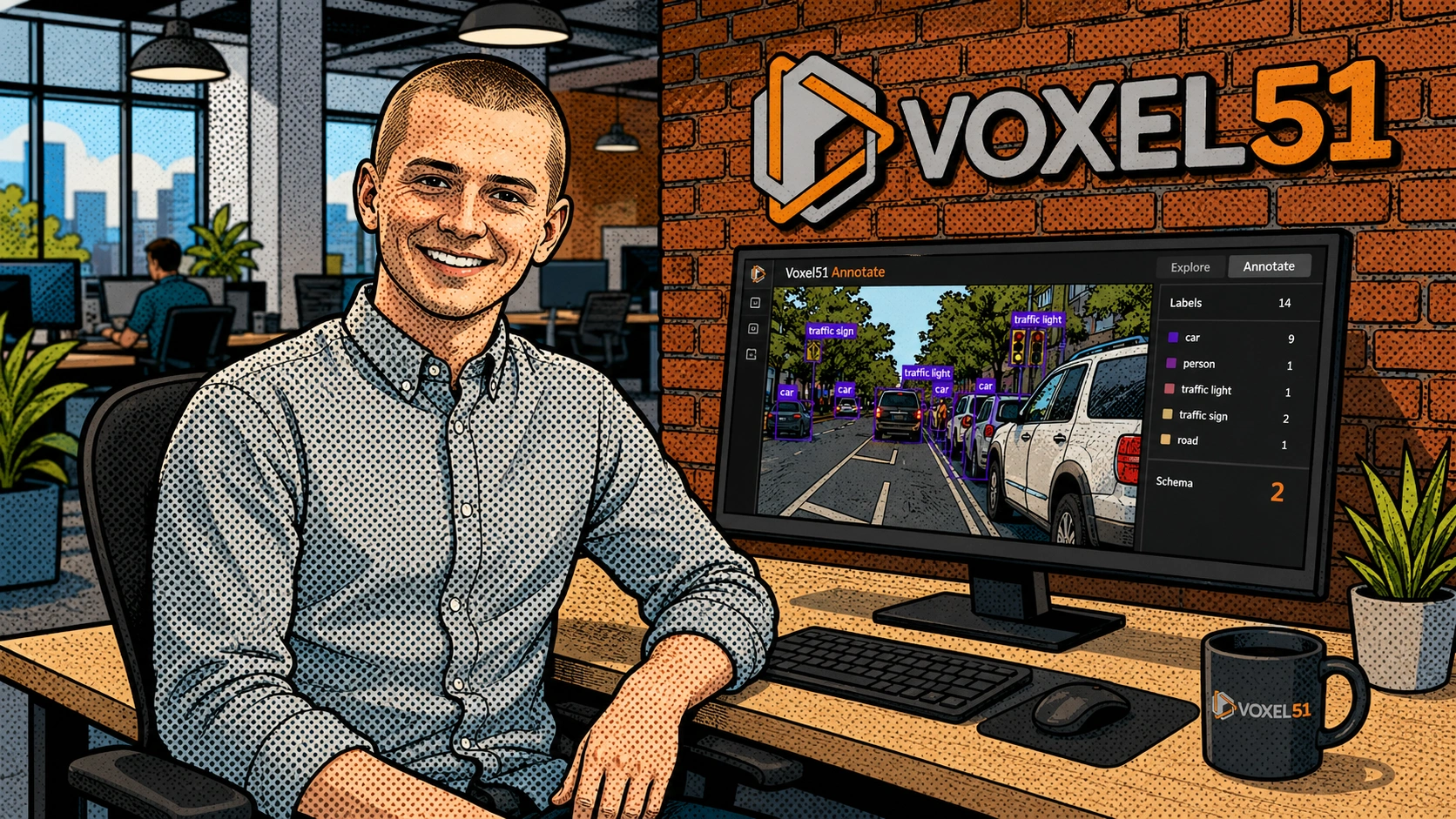
Voxel51’s software platform helps the people building that physical AI - which can include these autonomous vehicles, as well as robots or agricultural machines - to assemble the datasets, train the models, and catch the edge cases that help determine which of those two outcomes they get.
Sounds serious? That’s because it is. But if you met Moore at a networking event, ran into him at a dinner party or were standing next to him on the sidelines as your kids play soccer on the weekend, you may not realize that he never intended or even considered the possibility of becoming an entrepreneur.
First-principles thinking over credentials
Moore grew up in small-town Kansas, amongst a family of engineers who primarily worked in aerospace and defense. That may be the beginning and end of the majority of our stories when it comes to influence on the mind of a young entrepreneur: family of engineers, so they became an engineer. But Moore’s story is slightly different. His uncle was a physics professor at a local university, and he thought in a way that the young Moore found magnetic. He was, Moore says, someone forever trying to get to “how things work and why they work.” Moore credits him as the one who helped nudge him toward graduate school, although he admits having never told his uncle of his influence. We hope he’s reading this, and now he knows.
The curiosity carried him to the University of Michigan for a PhD in electrical engineering, which has little to do with circuits, he is quick to clarify. “I can’t wire a house,” he tells us, almost apologetically. Instead, he studied machine learning and algorithm development. It was there, through an adviser, that he met Jason Corso, a professor of robotics who had come up through the same electrical engineering department, and who would become the co-founder of Voxel51.
During his graduate years, Moore took an internship at Google where he helped build recommender systems - the kind that pick what you watch next on YouTube - and spent nights watching Google DeepMind’s AlphaGo beat the world’s best player in Go, a two-player board game based around gaining more territory than your opponent. It was the kind of tangent that he admits now probably taught him as much as any textbook or professor ever could.
Inspired by the uncle, his doctorate was never a career calculation. “At no point did I ever say ‘I really need to be the founder of a company’,” he says. Instead, he insists he always followed the abiding principle that sounds very much like that uncle: “I just want to know how things work.”
First-principles thinking, he argues, matters more than any credential — while many of the engineers he met at Google also held PhDs, he recalls that they were often in fields other than computer science.
Build a community, and they will come.
Voxel51’s origin may well reflect this accidental quality and first-principle thinking.
While the legal entity that became the company was formed back in 2017, it wasn’t created in order to chase a market, but rather to pursue a government grant: a public-safety program routed through The National Institute of Standards and Technology (NIST), in which the ‘company’ worked with the city of Baltimore on applying computer vision to its camera network to cut first-responder times. The grant ran roughly three years and functioned, in Moore’s telling, as a consultancy. The work itself was a different kind of lesson for him, however. Expecting to spend their time on model architectures, the team instead discovered they needed to wrangle, label, and fix data. To sort this problem once and for all and make their consultancy work easier, they built the software to do it for them. Then, in order to provide access for other organizations and see where it could lead, they made it available as an open-source model in 2018, labelling it as ‘FiftyOne’. It quickly found traction in the automotive, defense, agriculture, and retail industries and the community around FiftyOne grew at a rapid pace. That community now numbers some 100,000, according to the company, and spans a Discord channel, live events and more than 11,000 Github stars; all of which has helped deliver more than 5 million downloads of FiftyOne.
A year after that grant, a seed check of $2m from Michigan’s eLab Ventures followed in late 2019. “They had an unusual combination: the technical depth to architect something like FiftyOne and the customer obsession to know exactly what to build. That pairing is rare,” Doug Neal, co-founder and Managing Director of eLab told us when we asked him what prompted his fund to write that check. In Moore’s telling, it was only during the process of that investment that it became clear to him there was actually a company to be built around FiftyOne.
Moore started out as the CTO, with Corso in the role of CEO. A few years in, their interests diverged - Corso more towards the technology and the science, with Moore becoming caught by the bug of how things worked, this time with the business. Shortly after their Series A - with follow-up investment from eLab being joined by Columbus’ Drive Capital and Detroit’s ID Ventures, amongst others - the two swapped titles. It doesn’t happen often, and Moore frames it without drama: he had become fascinated by a new set of first principles. “It’s not true that if you build it, they will come,” he says. Far better, in his view, to “build something that 10 people love” than something a thousand people try once and abandon.
That respect for hard-won knowledge is evident in a story he tells about a conversation he had with an investor at Bessemer, a Bay Area VC fund which recently ranked #17 in Dealroom’s global ‘Power Law’ rankings, and which led Voxel51’s Series B. “Amazing investors. Love working with them,” he says. “I’ll include that,” I tell him. So here we are, leading into this anecdote… an investor at the fund told Moore the story of asking a successful founder what they wished someone had told them at the start; the advice that might have spared him the stress, late nights and the pivots. The answer was nothing. “If anybody told me how hard it was going to be… I never would have even tried,” Moore recounts, and it clearly resonates with him: “So don’t tell me anything. Just get in there.”
Building Community from Ohio.
Born and raised in Kansas, and attending the University of Michigan, Moore now runs the company from Columbus, Ohio, or within “enemy territory,” he jokes. The move followed the Series A, and was led by the Columbus-based fund Drive Capital, which came down to some practical possibilities: access to the firm’s talent network, and the potential for his family to find what they also needed in the city. The company went fully remote during the pandemic and has stayed that way. At 55 people and with roughly $50 million raised, the Voxel51 team is scattered across the Bay Area, New York, Austin, and Columbus, being pulled together at company off-sites twice a year.
Ask Moore whether location matters and he is almost indifferent. Remote work, he says, “gives us the ability to hire the best talent regardless of geography.” He never felt the pull to move to a coastal locale and his investors never pushed it, while no one, he claims, has openly questioned why an AI infrastructure company would be based in Columbus. The logical answer he provides for why that may be the case - a counter point to many of the perspectives we hear from other founders - is simple: “our company is nothing but the quality of the people that are at it … and the mission that we're focused on.”
The community around FiftyOne is one of the best manifestations of this ethos. Early advice from Voxel51’s chief community officer, Jimmy Guerrero — a veteran of MySQL and Red Hat — stuck with Moore: “enterprises don’t buy software from startups. They buy it from the people at the startups.” Some of the company’s most loyal customers, he notes, actually started out rocky and stayed because of how the team responded.
Infrastructure beats application, hands down.
Moore’s confidence about the future of his business and the problems they are trying to solve rests on where Voxel51 sits in the stack, and it comes back to data “eating models for lunch.” Infrastructure, he argues, is durable in a way the application layer is not; once you are the system of record for an enterprise’s data, you are hard to rip out, and an open-source core only deepens that. “There’s no incentive to replace something that’s open source,” he says. “The code’s already available. Just build on top of it … the ability to produce a lot more code will just entrench our product further because you'll vibe code more solutions that rely on it as a data source.”
He’s also proudest of a business decision that helped entrench this position. When the ‘ChatGPT moment’ arrived and many businesses piled into large language models, Voxel51 stayed with visual AI - what is now called physical AI - those systems we’ve mentioned that take in images, video, and sensor data and help other products act within the real world. His ambition, in his words, is to build “the Databricks of physical AI,” and he thinks the next breakthrough on that scale will land in his corner of it.
It is a bet he is making from the Midwest, albeit remotely with a global team. For a region that spends a lot of energy worrying about losing its best founders to the coasts, Voxel51 is an example: a company that decided that the question of location simply didn’t apply to it.
About Endeavor: Endeavor selects, supports, and invests in the leading high-growth founders building in elsewhere markets around the world — a selective network of 3,100+ founders across 50+ markets with access to global expertise, markets, and capital. Endeavor's network has produced 90+ unicorns, including the first in 15 countries, and backs its founders directly through Endeavor Catalyst, a $500M+ co-investment fund that invests alongside leading global funds like a16z, General Atlantic, Insight Partners, and SoftBank. Endeavor Midwest serves MI, IL, MN, and WI.