
On a chilly night in a restaurant nestled deep within the Mall of America, on the outskirts of Minneapolis, Minnesota, a founder from Tennessee and another from Brooklyn sit at a corner table on either side of me, listening to tales from the early days of Apple. The stories are being shared by local Jeffry Brown, whose job in the firm's earliest days was - in his words - essentially to predict the future and report it to Steve Jobs himself.
We’re in the Gopher State for the Hill Capital Summit and Brown is an example of the kind of person many of us may not realize are our neighbors. Alongside investors, service providers and advisors, together we’ll all spend the next day in groups pondering questions on growth, connections and what type of funding makes the most sense while some will ask the room for help to reach the next level.
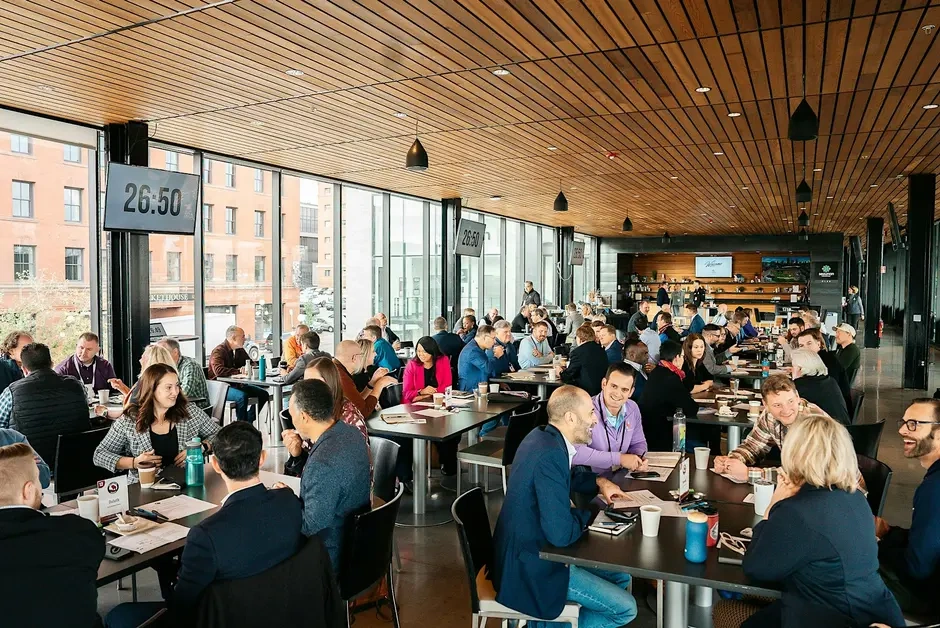
Inside the Hill Capital Summit in St. Paul, Minnesota
The summit is built on the premise that “entrepreneurs shouldn’t have to build alone,” according to the organizers, Hill Capital Corporation. One of the things most any entrepreneur building in the heartland of the country must consider is the best place outside their own town to look for connections, deals and potentially investment. If you're in Cincinnati, for example, should you consider only your own city, or make connections elsewhere in Ohio, or perhaps even across the border in Indiana? If you're in Wisconsin, are you looking south to Chicago, and maybe across the lake to Michigan, for your next market?
It was my first time in Minnesota, and I managed the full experience: the Mall of America on Wednesday night for the pre-event dinner where we met Brown, St. Paul for the event itself on Thursday, and on Friday I dropped in on the University of Minnesota's Carlson School of Management and our friends at Origin House. All this before the denouement of the whole trip: a total nationwide airline grounding that made international headlines, kicked off just as I sat in my economy seat on a plane leaving the gate, ready to fly home, and led to an impromptu road trip across five of the six states we cover.
It was, as they say, emotional.
Hill Capital Corporation is a Twin Cities firm that invests up to $1 million in growth-oriented, owner-led businesses. Under the theme The Rhythm of Growth, the day leaned less into specific stage programming talking at the participants than most events, and instead on facilitating active conversation: with three roundtable sessions on assigned, pre-chosen tables, a founder experience-sharing panel, and an afternoon exercise they called the Big Ask, in which participants put a specific problem to the room for their help.
Hill Capital's case for growth without an exit
For Nick Ehret, Hill Capital's Managing Partner and CFO, there is a problem inherent in founders being led to believe - by investors - that an exit is the only finish line. He thinks that leaves a lot of value on the table.
"Over time, we can produce so much more value," he told us. "You get to the point where you've built something sustainable. It's doing what you want it to do, and then … the inclination is to sell."
The alternative he describes is less glamorous than an exit and doesn’t play as well at dinner parties. "What about the next 20 years and the cash that you [could] take in during that period?" he asked. "The better outcome, in my mind, is to hold the business and let it compound longer,” a benefit he says - despite being a CFO - that isn't visible only on a balance sheet. "That can be better financially, but also mentally," he adds, because an owner who still wants to run the company gets to keep doing it, rather than spending all their time working towards a sale.
That's a long way from the venture model, and Hill Capital's funding is built to match.
The firm invests through what it calls a ‘Hill Note,’ and Kiley Shanks, an Associate at the firm, explained that it is paid back over time, on a monthly basis. It is an equity-based capital injection that therefore has some of the character of both revenue-based and mezzanine financing: "technically, it's debt, but we've designed it with equity in mind," she added.
The obstacle, she says, is that many founders don't know that options like these even exist. "They're conditioned into thinking that the only private source of capital outside banks is … [from] VCs and angel groups … VCs and angel groups play that power-law game. They just need one investment to make up for the rest. A lot of companies just don't fit that."
As a result, founders tell stories they may not even necessarily believe themselves. Shanks described a PhD student she met who had been advised to oversell their business. "He said he was told he had to tell the story that his company could become a billion-dollar business or he wouldn't get funding," she said, adding that "... if that's not you, don't tell it."
Swinergy: turning Minnesota hog farms into renewable natural gas
Swinergy founder and CEO Eugene Alvey is an example of someone at the summit and building in their own way. Swinergy has raised a $5 million seed round for its pilot and commercialization, but he told us that there “isn't a single fund on the cap table." How do you raise that much without one, we asked. "Get really good at hearing the word no," is his simple reply.
Swinergy has built technology that makes it possible to convert agricultural waste into renewable natural gas. Alvey explained that conventional anaerobic digestion needs very large operations to make the numbers work, something like 40,000 hogs at one site or 3,000 dairy cows. "That's not where most livestock are raised, though. Most livestock are raised on family-owned and managed farms," he said. "Our sweet spot is about 5,000 hogs or at least 500 dairy cows." The company's patented process separates the biochemical stages of digestion so each set of microbes works faster, which is what makes the economics work at ‘local farm’ scale. "We started in a place where no one else could have good unit economics," Alvey added.
Having grown up in the industry, he had the idea back in his college days, and kept working on it during his five years as an Army air and missile defense officer after he graduated West Point. Swinergy was incorporated in 2022, and Alvey says it has since raised about $750,000 in pre-seed funding and an as-yet unannounced $5 million seed round for its pilot and commercialization.
Location is one of the company's natural advantages. By Alvey's count, southern Minnesota and northern Iowa together account for almost 45% of all U.S. pork production. "If I want to talk to a hog farmer, I just get in my car and drive for an hour," he said. Investors are another matter. "People on the coasts, unless they came from the Midwest, don't understand the scale of the land or these farms," he said, so Swinergy's backers have come either from the agriculture industry or from energy. In July, the company cut the ribbon on its first commercial facility, on a hog farm near Ellendale, Minnesota.
He says Minnesota "might be one of the most well-endowed states from a natural resources standpoint," with mines and timber in the north, farmland in the south, Fortune 500 headquarters, medical technology and a strong university system. "And yet, we're failing to build meaningful new infrastructure in the state," he said, adding that he felt like every time they had a chance to do so, “we shoot ourselves in the foot."
None of that has soured him on the Minneapolis startup scene though. "I think Minneapolis punches above its weight from a startup ecosystem perspective," Alvey said, crediting Twin Cities Startup Week, where Swinergy was a Minnesota Cup runner-up last year, for introductions to investors and hires. And he is clear about why he came back after the army. "I was absolutely that kid when I was younger who said, 'I'm never coming back to the Midwest ... it's funny how home puts its hooks back in you and pulls you back."
What Minnesota investors want to see first.
Sean Williams, co-founder and COO of Owatonna-based FanSpark, isn’t a boomerang like Alvey, but moved to Minnesota about 15 years ago. He rates the entrepreneurial community as the state's biggest strength, with a culture of introductions and a willingness to help. The weakness, he says, is the conservative approach to investing, with investors wanting significant traction before they commit. One passed on FanSpark, he said, because it felt like a "very West Coast company," a reason we both found counterintuitive.
Miriam Ackerman of Duome backed this up. "People need everything to be proven prior to taking the first step," she said, explaining that they want it to “be a million in ARR before [they’re] even willing to look at it." She was careful to separate that from her hosts at Hill Capital, who "don't purport to be early-stage funding," but her conclusion was blunt: "We have absolutely no early-stage, real early-stage funding here." The best thing about building in the state, in her view? A track record, from Target to Best Buy, of ideas that became very large companies. "But now we need to put it back into action," she added.
The proof Minnesota investors want
Ackerman was at the summit to take part in the Big Ask, and her company is building a new way to address the problem of housing affordability. "In over 80% of counties across the United States, the median household income can no longer afford the median-priced home," she said, adding that this means teachers or firefighters may not be able to actually live in the communities they serve.
She makes the analogy of someone fortunate enough to have a rich aunt, someone who says, "Listen, I believe in you. I believe in what you're doing. I want to co-invest alongside you." Duome, a credit union service organization based in Minneapolis, plays matchmaker. Buyers take a credit union mortgage for their share, while a community fund of impact capital from foundations, nonprofits and similar sources co-invests in the rest - between 25% and 45% of the home, according to the company's website - as a tenant in common, sharing in any appreciation. "The one important thing is that the rich aunt isn't the company," Ackerman stressed. On a repayment for a $400,000 house, she says, a buyer could save more than $800 a month.
Stak Mobility and the founders who don't fit venture capital
Not everyone in the room was local. Diallo Powell, co-founder and CEO of Stak Mobility, was that founder at the table listening to Brown, and flew in from Brooklyn, New York, with a product that had already earned a nickname by the time we spoke. Someone at the summit had told him, "Oh, so you deploy big Pez dispensers for cars." "And I was like, 'Yeah, kind of that,'" he told us.
The EV Carousel combines industrial automation, EV charging and software. "In two parking spaces, we can park and charge 14 SUVs, going vertically up to 60 feet high," Powell said, with a digital platform that lets drivers park, charge and retrieve their cars. "It's almost like the problem found me," he added: his co-founder, an architect, kept seeing parking requirements kill development projects.
The problem finding the founder could also describe Sean Williams’s FanSpark. It’s a subscription social platform where athletes set their own prices for their most dedicated fans and keep 80% of the revenue. It began with Olympians in mind and widened to college, professional and retired athletes once his team saw how many of them need an income that outlasts a short career, or that replaces the second and third jobs some of them work to keep competing.
About 150 athletes are using the platform at present, with the need to be everywhere on social media meaning FanSpark is designed to be the first place an athlete publishes and to use clips on existing social accounts to send fans there. In this way, they hope, athletes can stay athletes rather than becoming full-time content creators. It's a familiar mission for Williams, the successful former comic book publisher who spent years helping creators in that field earn from their audiences.
It is apparent that these kinds of companies may sit awkwardly with traditional venture capital, or want to keep hold onto their business for longer than the venture model often allows. "We do something that's like heavy infrastructure. It's hard tech. It's not [a] traditional venture-type investment, right?" Powell told us. "But it's a really, really good sustainable business model with a high potential of aggressive growth." His investors tend to care about climate, impact and urban revitalization, and he heard something similar in Hill Capital's philosophy that morning, delivered by Managing Partner and CEO Patrick Donohue. "I think we're in an era where it's almost like, if you can't exit to a trillion-dollar IPO, then why bother building a business?" Powell said. In St. Paul, he felt he was "in the right room.
That line is probably a better explanation of the impact of this summit: where a founder looks for capital may actually matter less than finding the people who want to fund the business that already exists. Our latest look at Minnesota startup funding counted $310.3 million across 12 deals in the third quarter, but it can't count the companies that were told they were too early, or too West Coast, even, to get a meeting. A day of roundtables won't close those gaps, but it did put founders who don't fit the venture template in a room with investors who aren't asking them to, and that's probably a conversation that the region could stand to have far more often.