Alexander Lüking’s company, FibreCoat, manufactures a fiber that is a fifth the thickness of a human hair. The material can be used “around a battery for EV,” he explained, “and shield the battery from electronic waves … At the moment, it is done with thick aluminum plates, or very fragile aluminum foil.”
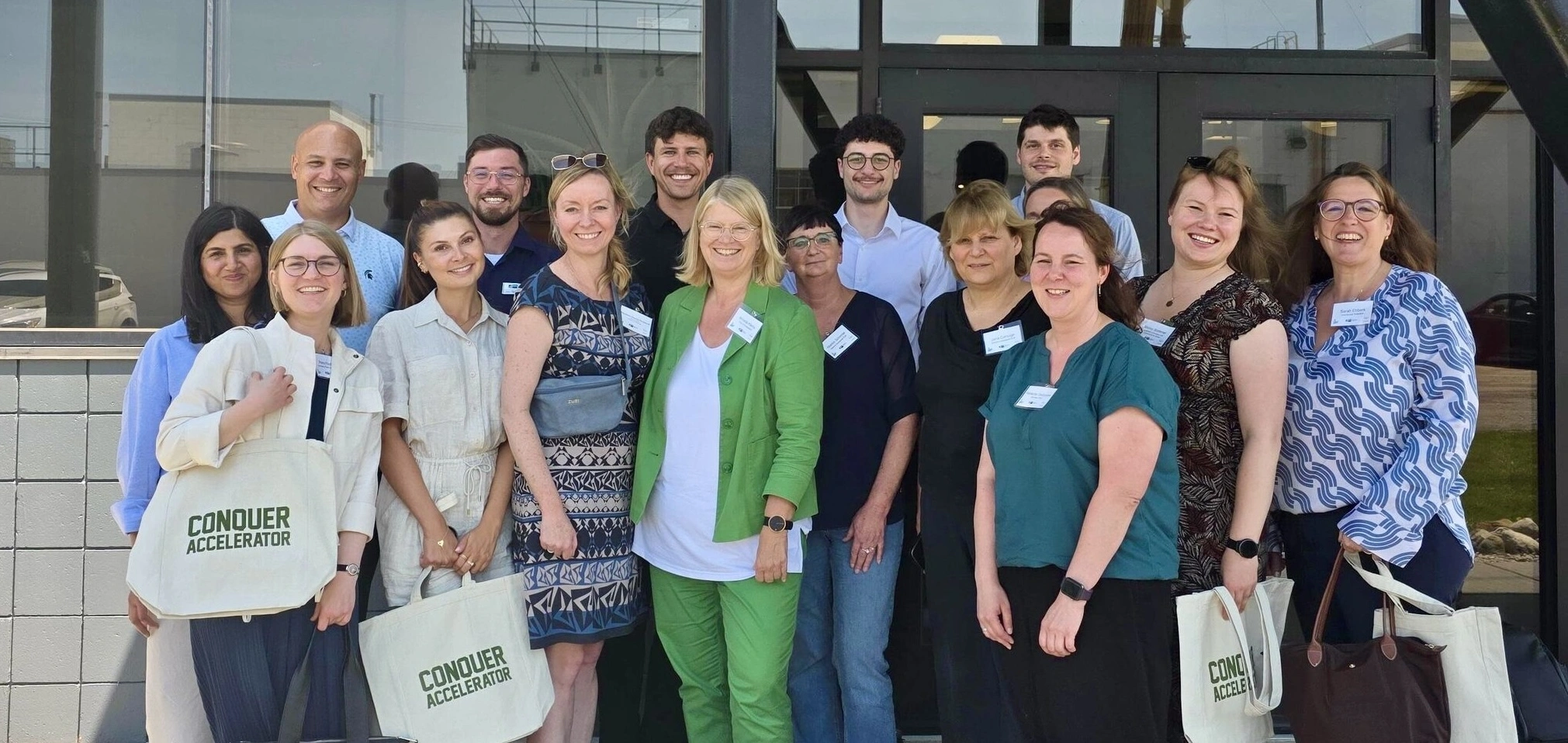
Lüking was one of a dozen or so German entrepreneurs and economic development organizers who spent the past week in our region, visiting Detroit, Lansing and Chicago, and at the end of the summer a local group will make the return visit.
What caught our attention when we spoke about these visits, and Lüking described the region where his company began - the German state of North Rhine Westphalia (NRW) - is that he could very well have been describing the Midwest.
A group of economic developers walk into a factory
The Midwest visit was part of a program run by the German American Chamber of Commerce of the Midwest, to connect hard tech and deep tech experts across manufacturing and industry in our region with those in NRW. The direction will reverse in September, when a contingent of Midwest companies and economic development organizations spend a week in FibreCoat’s home region, touring the same kind of testbeds, universities and scale-up programs as the German delegation has done on this Midwest trip.
North Rhine-Westphalia is coal-and-steel country that has spent a generation trying to evolve beyond that history. It has big research universities, a proud engineering base, and the same de-industrial hangover that anyone who has driven through Midwest towns and cities can recognize.
Petra Fischer, who looks after international startups for Germany Trade & Invest, draws the same analogy. "Both regions have strong industrial traditions, world-class engineering capabilities, and globally competitive sectors such as automotive, manufacturing, mobility, chemicals, and life sciences," she told us. This complementarity is where the potential of such an exchange lies: In this case, rather than Berlin to the Bay Area, it’s Dortmund to Detroit and back.
When we ask an entrepreneur like Lüking about his own region, he becomes effusive. “The politicians are very bold right now, which is not very common for German politicians, to be honest." He traces the shift to the mid-2010s: money moving into the startup scene, into places a cautious German bureaucrat may once have avoided. "They're investing heavily into things," he says, "Like, for example, space."
He mentions Garrelt Duin, a local minister who ran economic affairs, energy and industry in the state government from 2012 to 2017, who made structural transformation, the renewable-energy shift and a push for Industry 4.0 initiatives effectively his own private brief. That state’s Premier at the time, Hannelore Kraft (Duin’s boss) even told the Financial Times back in 2010 that the region’s companies could only keep a leading position through innovation, in her opinion. “For that,” she told the FT, “they are prepared to reinvest a great deal in their own companies. And … they know that their success at innovation depends on the brains of their workforce.”
This is where our Midwestern ears prick up, because many entrepreneurs in the region often tell us that they feel local corporations have often done the opposite. Faced with a nearly identical industrial inheritance, the Midwest's instinct on corporate capital has often been one of caution — a reluctance that we’ve shared before in the context of a thin investment year and limited engagement from local corporations.
One of our Midwest locals has a better understanding of the parallels between the two regions than most.
Wiebke Hagendorf-Schroeter is originally from Northern Germany. Based in the Midwest since the early 2010s, she spoke in front of the GACC contingent on their Detroit leg, and told us that local entrepreneurial support was more a feature here than in Germany. “Founders can move from research to customer discovery, manufacturing expertise, investor readiness, and funding through a network that is collaborative rather than competitive,” she told us. “That connectivity helps founders build companies - not just technologies.”
How Germany scales without coastal venture money
Fischer pointed out that "many German startups scale through close collaboration with corporate partners rather than through a pure venture capital approach." When asked to expand, she was specific. Growth in Germany, she said, "is often driven not only by venture capital but also by partnerships with corporate customers, pilot projects, joint development activities, and industrial networks."
The data bears this out. Between 2019 and 2025, startups in the NRW region have raised an average of $750 million a year according to data from Dealroom. That’s for a region which accounts for close to 20% of the national GDP, and results in a Funding to GDP ratio of 0.08%. Compare this with our region - despite its own issues in this regard - where the latest figure we have was 0.19% in 2024.
Much of that economy within NRW is built upon the back of what Germans refer to as the Mittelstand, rather than the global German household names you may know well. The Mittelstand is the roughly 85,000 specialized, mostly family-owned mid-sized firms that quietly dominate niche markets and have functioned as the backbone of the German economy for the last 80 years. For a founder, a Mittelstand company is not just a customer; it can be a potential co-developer with a large balance sheet and a complex supply chain from which to learn and evolve.
That connection may also be breaking though. Fischer pointed us to the German Startup Monitor, an annual report from the country's startup association Startup Verband, which flagged a recent decline in startup-corporate cooperation as presenting a genuine risk to their ecosystem, precisely because that cooperation matters so much.
Lüking is a walking example of this thinking around the corporate-startup ‘partnership’. He did not come to Michigan to move product, he says. "I'm not going there to sell something, I'm going there to find someone who is equally attracted to us [as] we are to them." What he wants is a U.S. partner to co-develop with — someone who can open doors in the aerospace and defense industries, which can often be closed to foreign companies. That partner, in exchange he says, will receive a direct route into European markets. That is a different transaction from a sales lead, and it is the kind of relationship Fischer says these trips exist to seed “where collaboration can create tangible business opportunities rather than just networking.”