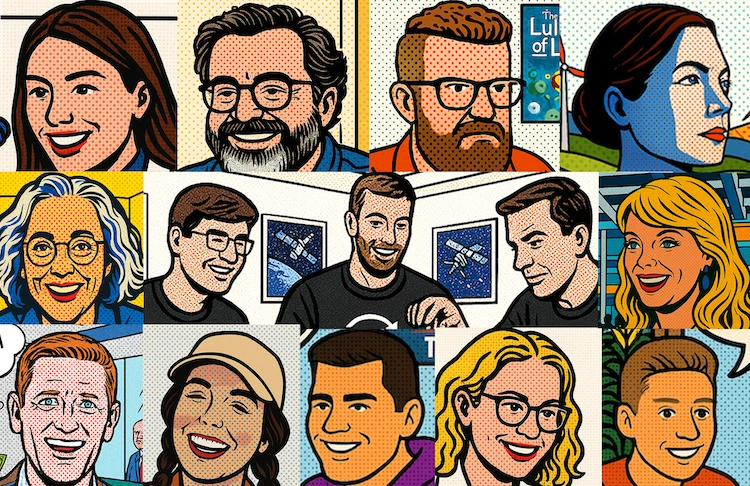
This year we published 11 of Midwest startup Founder Stories, focused on some of the fantastic people, entrepreneurs and startup founders behind these great Midwest businesses. These are amongst our favorite stories to collect and write, and represent totally human and occasionally messy snapshots of what it looks like to be an entrepreneur and build innovative companies across the Midwest right now.
Our first ever story dropped on July 21 with Blake Mischley of MeetYourClass. From there, the series acted like a kind of rolling documentary: 13 founders, an almost 50/50 male to female split, with +$25m raised collectively across edtech to space, biotech, fintech, cleantech, gaming, CPG, martech, and media.
The geography matters too. Five of our Midwest startups have come from Michigan - primarily due to proximity and connections - alongside two in Indiana and two in Wisconsin, another in Ohio and the final piece of the puzzle being a team in Iowa. Yes, we know… but we’ll address that in a second.
If you’re reading about these stories for the first time, consider it your ‘founder guide’ to the year on our pages. And if you’ve been following all along, consider it your “how the hell did all that happen in six months?” recap.
What’s most interesting is how much - across wildly different industries - the founders in our region kept returning to the same set of themes: often those that we hear when people stop pitching and start telling the truth. That’s what happens when the focus is on the person, not just what they’ve done.
1. The Midwest isn’t just where we’re from. It’s a strategic choice
Founders don’t stay here out of nostalgia. They stay because it works for them. Or at the very least, because they want it to work enough to commit.
In that very first story, Blake great example of the kind of clarity that makes Silicon Valley, coastal myths feel a bit… ridiculous: “If we were a cookie-cutter B2B SaaS, maybe San Francisco makes sense, but our customers are here. The community is here. Why leave?””
That same ‘build here on purpose’ energy showed up in Indiana too. RJ Talyor of marketing tech business Backstroke described the support networks that he felt were necessary: “Building a startup is really, really hard… and knowing people in the city who I can call for a coffee or a pep talk… is really, really valuable"” he told us in his founder story.
And then there’s the Iowa exception - which is why it’s worth including. Scott Burak & Bryce Bortscheller of Map Dot Media, the company behind the viral hit Midwest vs the Rest social accounts, have never treated leaving as an inevitability. Instead they described staying as the best advantage they could leverage: "It feels awesome to celebrate the region… we have this very cool thing that's underrepresented, and even if we weren't raking in the dough, for a lack of a better term, because this space was underutilized … it felt prideful to represent our people” said Bryce.
But of course, the strategy can also cut the other way.
In our final founder story of the year, Charlie Childs & Madeline Eiken of Intero Biosystems gave us the most honest version of the Midwest reality: that you can build a great team and fall in love with a place but still outgrow its infrastructure such that you need to leave. As we explained, “there is a combination of factors at play here: the business infrastructure in their new location provided turnkey lab space with equipment provided, a talent market dense with biotech professionals, better access to coastal customers, and predictable state R&D funding.”
2. Capital is a tool not a flex: and doesn’t always mean VC
If there’s one thing we can say became clear in writing these stories, it's that many founders - including many outside our Founder stories - are quietly done with fundraising theatre.
Some built with tiny injections of capital and a lot of execution. Some leaned into non-dilutive funding. Some bootstrapped. But the common thread was realism: raise money to do something, not to look like you’re doing something.
Take Troy M. Morris of Kall Morris Inc. Space is not a ‘move fast and break things’ category. Troy described a funding reality that looks very different from SaaS: “Funding, totalling $7.5 million thus far, has been ‘six-to-one… non-dilutive government contracts versus traditional equity,’ Troy says.”
Back in Indiana, Heather Jackson of iXplore made the case for grant funding not as consolation prize money, but as an ecostartsystem-builder: “The more we tap into grant funds… the more we can build small regional ecosystems telling that region’s story to that region’s kids.”
And in Michigan, Beth Hussey from Shifty reminded us that ‘capital’ doesn’t always mean venture capital funding when you’re working in more ‘traditional’ industries. Her staff training app came out of the fact that she had her own restaurant, but she had grafted to get there: “I just always assumed I couldn't open my own place because I would need some big money behind me… but it was [because of] my reputation and my business plan,” that she was able to secure finance from a bank, open her first restaurant and build from there.
3. Midwest startups work ethic is about lived experience
Almost nobody in this cohort started out wanting to be a founder. They often started as workers. And that matters.
Ryan Rybolt of Payload has built a few ventures himself, but his work ethic and entrepreneurial operating system comes straight from the vegetable fields: “You’re not going to leave the field until the last row is hoed,” he told us.
And Beth Hussey’s story is soaked in a similar energy: decades in hospitality before building software for restaurants. It’s not theory or a sudden bright idea, it’s reps.
But Laura Markewicz of Lotza probably put it best (and a little sweary, which we approve of) when she said “I think a lot of entrepreneur stories begin with like that holy s*** moment, like YOLO, if we are in this life not pursuing something that we love, what are we here for?”
4. Community is the difference between quitting and ‘keep going’
When people ask “what’s the Midwest advantage?” founders rarely say “cost of living,” although it is part of the conversation. Most often, however, they talk about the people that show up.
Sometimes, that means an audience. Sometimes, it means mentors. Sometimes it means someone answering a DM and changing the entire trajectory of your business.
For Ben Kvalo of Midwest Games, that long-game relationship-building showed up early in his career and stuck until the moment it was activated in-person, on a visit to his alma mater while back in town from his high-profile Netflix job: “While touring TitletownTech - the venture firm launched by Microsoft and his beloved Packers - he pulled aside Managing Director Craig Dickman. ‘I was like, ‘Hey, I have this idea in the back of my head. I'd love to chat about it’. Two hours later we emerged from a full whiteboard session.’”
Meanwhile Kerry Duggan talked about the accessibility of even those at the ‘top’ of her local entrepreneurial food chain: “the resource that’s hardest to quantify but easiest to feel when you’re here [is]: a different social contract for builders. Accessibility matters. ‘Dug Song and Dan Gilbert are accessible,” she said. “There is something about being from here.’”
We like to think that these aren’t throwaway lines. That they’re proof that there is a Midwest founders community, that community-building is a skill, and that it can compound if we let it.
5. The real differentiator: learning velocity
This year also made something painfully clear: many founders are still building inside systems not necessarily designed for them — and yet they build anyway.
Laura Markewicz didn’t lead with wellness jargon. She leads with brand truth: “If one word describes our brand, it’s fun. If one mission describes our brand, it’s fun,”
The Intero founders are both technical and learning fundraising by doing it, while paying the ‘founder tax’ you don’t necessarily see in pitch decks. Charlie Childs described a period of rejection that basically sounds like startup prep disguised as grad school: “I did not win a single thing in grad school… my papers got rejected like seven to eight times… My CV was so bad… I was always like, am I cut out for this?”
And Madeline Eiken captured the emotional truth of hard calls — including the ones that upset people: “This is probably the scariest thing we’ve ever done… and then we were like, wow, that was the bravest thing we’ve ever done,”
If you want a summary of what we’ve covered this year, it might be this: Midwest startup founders might have less access to many resources which other parts of the country take for granted, but they aren’t short on ambition. They’re also impatient with narratives that don’t match reality.
The part we need to own
We’ll end this story with a mention of where we think we need to do better. For example, we’ve failed so far to feature more founders from underrepresented backgrounds in our stories… and that’s on us.
We’re working on it - and are lining up stories we hope to share soon - but if you know a founder story we should be telling, please send it our way by emailing us here. The entire mission of StartMidwest is that the Midwest is bigger than you actually hear in even the loudest rooms, that we can build a viable and interconnected startup ecosystem here to break the status quo and that the best stories rarely come pre-packaged. We need to find more of them.
And if you want to go deeper (or just binge all at once), our People page is the easiest way to find them, and here are links directly to each of the 11 stories referenced throughout this page:
Blake Mischley — MeetYourClass (Edtech, Michigan)
Heather Jackson — iXplore (Edtech, Indiana)
Beth Hussey — Shifty (Edtech, Michigan)
RJ Talyor — Backstroke (Martech, Indiana)
Troy M. Morris — Kall Morris Inc (Space, Michigan)
Laura Markewicz — Lotza (CPG, Wisconsin)
Ben Kvalo — Midwest Games (Gaming, Wisconsin)
Kerry Duggan — Energy Security Partners (Cleantech, Michigan)
Ryan Rybolt — Payload (Fintech, Ohio)
Scott Burak & Bryce Bortscheller — Map Dot Media / Midwest vs… the Rest? (Media, Iowa)
Charlie Childs & Madeline Eiken — Intero Biosystems (Biotech, Michigan)