
Ecosystem
July 25, 2026
PitchMI startup competition: $2 million, but are attention and hype the real prize?
Phil Vella
Become a member & keep reading for free, or choose a paid membership.
Access all our content & email newsletter
Michigan's statewide pitch competition, PitchMI, will restart this year with semifinal events this September, and two new cities hosting including Marquette in the state’s Upper Peninsula.
Applications for the 2026–27 edition of PitchMI are open, closing at midnight on August 10. As with last year’s edition, there will be four semifinals with the first on September 24th, each carrying $250,000 and feeding into a Final round in April 2027, where one business will take away a further $1 million.
Last September, we asked whether a competition like this could help shift Michigan's startup trajectory. With the first year complete, the early answers may be that outcomes away from funding could actually provide the bigger long-term value.
What happened in Year One of PitchMI?
While expectations last year were high, matching the funds devoted to a program we said “may well be the largest state-based pitch competition in the country,” the actual outcomes exceeded even those expectations. “We were hoping that we would get maybe 200 applications," Pete Martin, the Director of Portfolio Management at the Michigan Research Foundation (which manages the competition events and funds) told us, “I think we [had] 375 applications … from all across the state … from 100 cities and towns on both Peninsulas.”
That geographic spread may also explain why two cities - Ann Arbor and Traverse City - are not hosting semifinals this year, being replaced by Kalamazoo in Western Michigan and the aforementioned Marquette in the UP.
Alison Todak, the Michigan Economic Development Corporation's (MEDC) Vice President of Entrepreneurship and Innovation, said she was surprised last year not by the volume of applications, but the spread. "It's not concentrated around specific spaces," she says. "There really is entrepreneurship in every corner of our state."
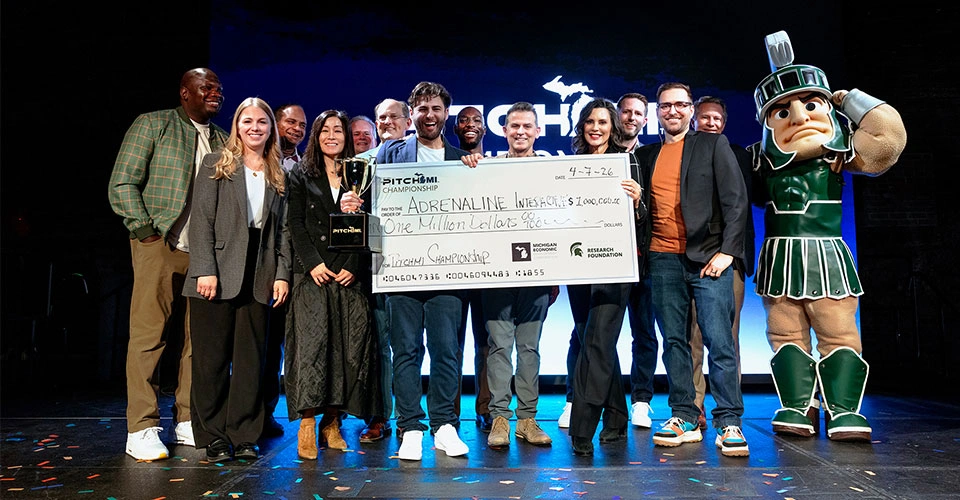
In the end, the 2025–26 startups taking part were awarded a total of $2.3 million — a little above the previously advertised pool, as local investors added their own checks, sometimes announced live on the night of a regional event.
According to both Martin and Todak, the top 20 semifinalists last year have also collectively raised $8 million in additional funds since taking part in PitchMI, a number Todak thinks “is only going to exponentially grow as they continue to scale these … first cohort of companies.”
An investment, not a prize
Michigan has been here before of course.
Between 2010 and 2019, the state ran a competition known as ‘Accelerate Michigan,’ but the uncertainty of the pandemic put paid to the 2020 edition and the event never returned. Todak mentions Accelerate Michigan in citing the success which businesses can enjoy by taking part in such competitions. Orbion Space Technology - headquartered in the Upper Peninsula town of Houghton - is one such example of potential outcomes for state-backed, early-stage funding. Orbian took away $500,000 from Accelerate Michigan in 2017, subsequently raised a total of $30 million over its lifetime and was acquired in March this year by York Space Systems. While the acquisition figure was not revealed, York - based in Colorado - is listed on the New York Stock Exchange with a market cap of $2.32 billion at the time of writing.
According to Todak, PitchMI was born out of the collective push from the local Michigan entrepreneurial community which produced the Michigan Innovation Fund in 2024, a one-time $60 million appropriation. While most of that amount is directed to nonprofit venture funds, it also included the funding that would effectively bring ‘Accelerate Michigan’ back from the ashes to become PitchMI through the “legislative carve-out for a statewide pitch competition.” Signed into law in January 2025, approved by the Michigan Strategic Fund Board that April, put out to tender, and subsequently won by the MSU Research Foundation to manage the competition and the investment dollars, because, in Todak’s opinion, "the state should not be directing investment into companies directly."
The funding mechanism and history of similar initiatives in the state matters because at present, there is no mechanism to guarantee PitchMI will exist beyond this 2026-27 iteration; a fact perhaps placing an undue amount of weight upon this year’s events.
In the attention economy, visibility may be the most important outcome.
Speak to the founders who participated in PitchMI about what they gain from being part of such an event, and funds are not what comes up first. The eventual winner was Adrenaline Interactive, an ad tech platform for gaming. Its CEO and Co-Founder Max Albert said in this year’s PitchMi launch video that beyond the funds, mentors and connections, PitchMI helped him hone his “presentation, branding and fashion skills.”
Lindsay Joseph, Co-Founder and CEO of BedConnect, an online system that shows hospitals which nursing-home beds are open and who was also one of last year's four finalists, described the value as access and connection rather than straight cash. "You get to present in front of a crowd of investors, fellow founders, business leaders," she told us, adding that it “enables an early-stage startup to leapfrog into a level of credibility that helps them continue to grow their business."
Joseph comes from the corporate world, having been a CFO in the health industry prior to launching BedConnect. She said that when she started her business, she had no knowledge of the state's smart zones or that their funding existed until other founders told her. That knowledge gap is one Todak says PitchMI can help close alongside the funding and getting more businesses in front of investors. Venture Capital, she argues, is not yet a widely understood asset class locally. "Money has typically been conservative in this region," she says, and closing that gap requires "a little bit of the hype and the FOMO" that events like this can provide.
Martin frames the whole competition in similar terms — as a beacon, and the best available way to see at scale what is being built in Michigan. His ambition for year two is simply more of it: more applications, more attendees, more media coverage, more people backing these companies.
In that wish he also mentions a detail he hopes the founders applying don’t skip past. "One of the last questions on the application is, ‘are you OK if we share information about you and your company with other investors.’ Just by applying we want to share your information — not [just] your pitch deck — with other investors in our network so that they can know that you exist."
Such information sharing - so that investors can know about these companies - also highlights what the modern attention economy may often forget. "Entrepreneurship is extremely lonely," Joseph told us, highlighting the fact that the four finalists became close friends. "The more community that you can build, the better."
The 2026–27 PitchMI schedule
To apply for PitchMI, a company must be headquartered in Michigan, founded in 2021 or later, have raised under $2.5 million in dilutive funding and not currently have more than $1.5 million of revenue over the last year.
The dates to make note of are:
- August 10 — applications close at midnight
- August 31 — semifinalists are notified for each respective category/location, which are:
- Sept. 15 — Defense & Aerospace, Grand Rapids Civic Theatre, Grand Rapids
- Sept. 22 — AI & Software, Kalamazoo Civic Theatre
- Sept. 24 — Advanced Manufacturing, Materials & Outdoors, Northern Center, Marquette
- Oct. 1 — Healthcare & Life Sciences, The Department at Hudson's, Detroit
Martin, for his part, keeps returning to a perception problem, one we’ve also highlighted many times on these pages: Michigan is considered an automotive state and not much else. He thinks that is a fraction of the real picture — pointing to, among other things, its clean tech record, where recent national tallys place the state first in the country for projects in that field since the Inflation Reduction Act was passed in 2022.
Last year we wondered whether a single large check could change a founder's trajectory. A year later, the more useful question may be whether the state gets to keep offering it at all… and whether capturing our collective attention may actually be the highest value outcome we should all be hoping for.
Trending Stories
Latest Videos
All Rights Reserved
Copyright 2026 Zeroto7 LLC
Powered by: