
Become a member & keep reading for free, or choose a paid membership.
Access all our content & email newsletter
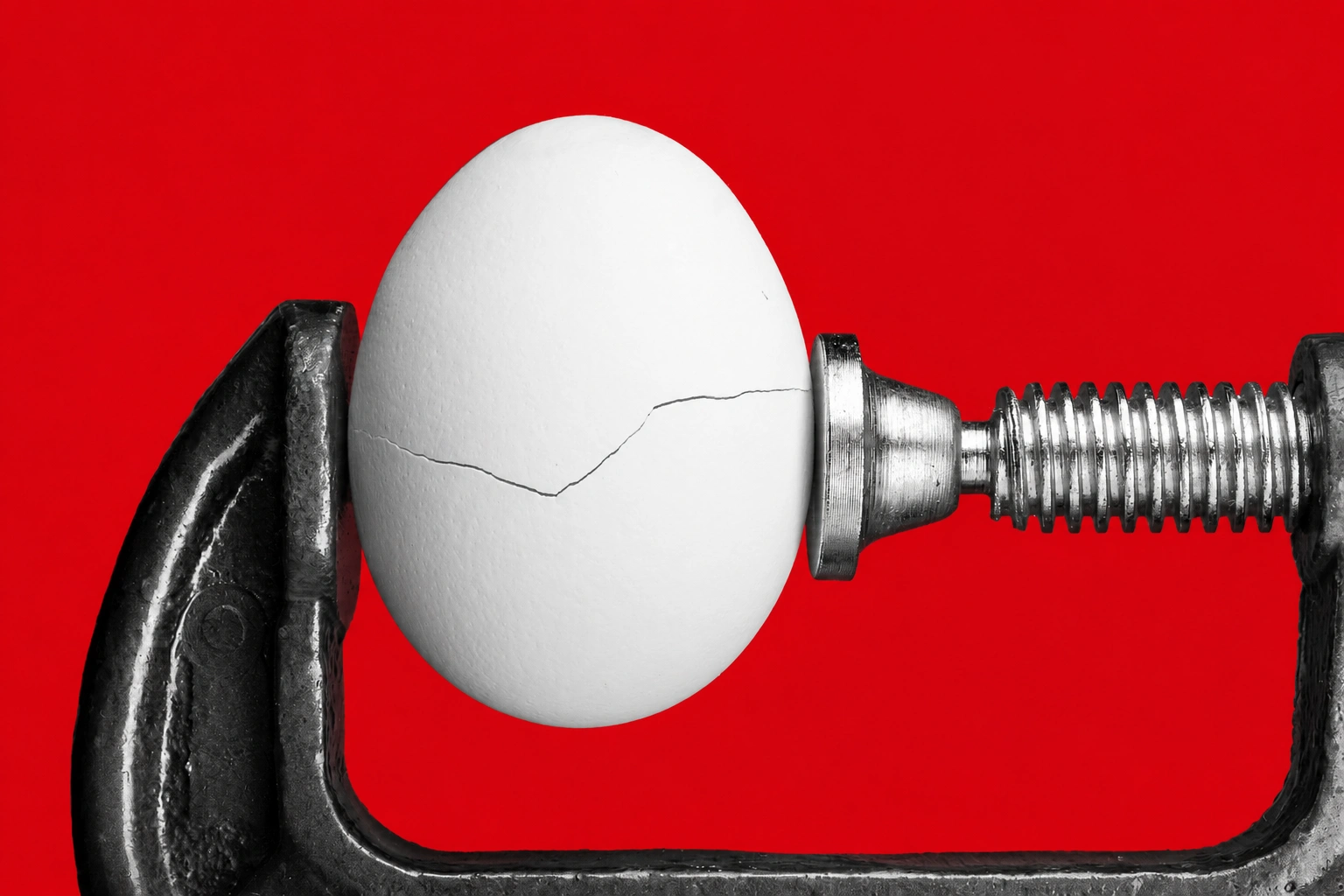
A 2024 study by University College London about the experiences of 400 founders from around the world found a few sobering statistics on founder life away from public personas: 93% of founders reported mental health strain, with anxiety levels five times the national average, whole 52% of founders felt like the pressure they're living with is a 7 out of 10 or higher, which increased to 71% of founders of funded startups.
If you stay long enough at a Midwest happy hour after the pitches and talking points fade, you'll start to hear more on this story. Someone mentions a contract that went sideways. Someone else nods and says, "Yep. Been there."
That public persona of LinkedIn posts, panels, and news releases is one thing. There is also the founder life built in the trenches of operational, financial, relational, and market pressures behind the scenes.
The Hidden Toll of Cumulative Pressure
Dr. Danny McGuire, educator, author of Hard Reset: Reliability Under Pressure, and founder of Crosstown Coaching, has spent years studying what pressure actually does to leaders over time, and he says most of them miss it happening. "Leaders tend to underestimate cumulative load because they mistake endurance for effectiveness: if they can still show up and produce, they assume pressure is not changing how they lead," he said. "The early warning signs are small losses of reliability - less patience, narrower thinking, poorer listening, and decisions driven by urgency rather than values - long before any visible breakdown."
A 2024 report by University College London found that 76% of founders feel lonely, which is 50% more than CEOs generally.
The 2024 UCL report found that 76% of founders feel lonely, which is 50% more than CEOs generally. Sometimes, a founder can feel compelled to 'lock in' alone to build. That can work, but not as a long-term strategy. This is especially true in light of something researchers have found about isolation, too. Research shows that the longer someone stays cut off from other people, even productively, the more their nervous system starts treating ordinary social encounters as threats. It's adaptive for a week. It's corrosive after a year.
How do you know when locking in has become counter productive? How do founders see the moment to pivot?
Practical Lessons in Navigating Pressure
Danny Ellis has stories about adapting to pressure. He remembers exactly what it felt like to watch $100,000 disappear. Not stolen, not lost to a bad market, just gone, engulfed by a contract dispute. "We thought we had a huge uptick in business but ended up almost running out of money," said Ellis, owner of Side Quest Strategies and advisor to many startups. It's the kind of thing you'll often hear from a founder in the same way you or I may talk about losing our glasses or the TV remote. "This taught us how to better negotiate contracts and manage large scale projects."
I've heard some version of this many times. Numbers change. What broke changes. But the tone remains; a kind of hard-won, matter-of-fact honesty that is only obvious after someone has made it out of the fire.
Financial pressure has a way of making everything else in a startup feel optional and urgent. Ellis puts it simply: "Always look for what you can learn from failures. Failures often provide the best learning opportunities."
Money is rarely the only thing under strain.
Ask any founder what breaks first, and it's usually the operation itself. Jonathan Weyhrauch, founder of Capture Tech in Troy, Michigan, learned this when one co-founder resigned without warning. "While learning to operate in a new market and deploying new tech, there can be some chaos as you encounter unseen hurdles," he said. "You don't get to have a smooth plan all the time and need to act in the moment. It is a hard thing to lose someone you are building your idea with, but that is easier than the alternative danger of building with the wrong person."
Losing a business partner is painful. Building with the wrong one is worse.
Product pressure shows up less as a loss and more as urgent demand. Saif Akhtar, founder and CEO of Modulo Labs in Detroit, Michigan, described the moment his team had to drop everything to deploy compliance tooling on a DeFi product. "This requirement was a blocker to proceed, so we had to drop everything and push," he said. That's just the reality of a startup; the roadmap you planned and the roadmap you're forced to build are rarely the same.
And sometimes the pressure isn't operational, but a matter of persuading the right person to pay attention. Isha Naik, founder and CEO of Treeo in Detroit, Michigan, needed a mission-aligned cardiologist early on and didn't know one. "After dozens of calls and many more declined invitations, we finally found the right partner, and this set the stage for us to launch and test our first product," she said. "I started with little to no warm connections in the industry I decided to build in, but putting myself out there relentlessly gave me the confidence to build a strong network myself." The lesson that has stuck with her since: "If a path isn't working, build a new one."
That seems like a particularly Midwest resourcefulness: Grit over glamor.
Then there's the market pressures. Gwen Betts is based in Toledo, Ohio and is co-founder and Chief Experience Officer at Maro. She described watching competitors mirror her company's messaging and features within a week or two of launch. "This couldn't be more true now in the era of AI where advancements every day mean new opportunities to build smarter, but your competition also has that advantage," Betts said. "AI makes it possible to point an agent at your website or product, draft the brief, and build things directly." Bett's advice is to reframe this risk. "If the market is following you and your company's beats, you're the strategy leader and have the edge. Use it as your sword and shield."
AJ Rosado, founder of Noetic AI in Cleveland, Ohio, said it became clear when he started frequenting networking events, that a higher level differentiation could create competitive advantage. "The riches are in the niches and luck favors the prepared," said Rosado. "Niches can be a particular market, offering, tech stack, clientele, or geography… what will be perceived as expertise, ease, flow, and connection will be mistaken for just a crap-ton of preparation. But prep without action is just recreational reading."
Maintaining Clarity Amidst The Storm
These founders had the clarity to change course. But how do founders maintain this clarity over a long period of accumulated pressures? Or, do circumstances simply confront them with no other option but to adapt?
That's what runs through every one of these stories. Anyone who has spent five minutes in a coworking space knows that founders face pressure. Pressure accumulates over time, in biology, operations, and relationships. What is not always obvious is who a founder can trust in the moments when the chips are down.
These founders know that pressure is part of building something that didn't exist before. The advice they shared here is hard-earned and specific. Adapting to pressure is, after all "the name of the game for startups" says Betts.
Maybe that's the most Midwest thing about how these founders say they manage pressure: you often don't talk about the weight, until you've already already figured out you can actually carry it.
Aria Spears leads cross-functional projects in Michigan’s startup ecosystem at Michigan Founders Fund. She’s worked in community-building organizations for ten years, is a Duke grad student studying community innovation, and previously lived in Fayetteville, NC.
Read more on this topic
All Rights Reserved
Copyright 2026 Zeroto7 LLC
Powered by: