Over the course of the last two weeks, two of the Midwest's startup gatherings arrived at a similar conclusion. In Minnesota, a panel of venture investors told a Twin Cities Startup Week audience that the state does not have a capital problem. In Ann Arbor on Friday, investors and founders at the University of Michigan's Venture Summit focused less on how much money is available than on what deserves it.
Next week the conversation moves to Cleveland. JumpStart VC Fest, formerly Ohio VC Fest, and Start Midwest will moderate a panel on how startups and the region's legacy industries can work together. Taken together, the three events come at the conclusion of the busy summer events season and demonstrate a region that increasingly locates its constraints outside of capital: in ambition, in talent, and in the distance between a promising idea and businesses that truly scale.
Minnesota: plenty of money, not enough scale
At the Minnesota Capital Forum hosted by Twin Cities Business magazine, the panel consisted of Rob Weber of Great North Ventures, Mary Grove of Bread and Butter Ventures, Pat Meenan of Arthur Ventures, and Ryan Broshar of Matchstick Ventures, moderated by Lucas Giambelluca of Bank of America.
Meenan was blunt, quoted by TCB as saying "I don't think there's a capital problem whatsoever." The rest of the panel seemingly agreed. They pointed to a venture ecosystem that has expanded quickly in recent years and to public programs such as the state's Direct Investment Venture Capital Program. That program is managed by the University of Minnesota and backs seed and early-stage companies based in the state.
TCB's own reporting in August complicates that story, however. Drawing on a Greater MSP analysis that sourced Dealroom data from our shared Midwest Innovation Ecosystem, it found that the Twin Cities does well on early capital but falls behind smaller comparable markets once companies need later-stage funds. Salt Lake City, for example, has produced nearly three times as many unicorns and nearly twice the total startup value.
Adialante, an MRI technology startup spun out of the University of Minnesota, moved to California after joining Y Combinator. Co-founder Efraín Torres told TCB that local funds demanded five times the diligence Sequoia Capital did while offering far less money on worse terms. "The investors [in Minnesota] are too conservative," he said in their August story.
Back at the panel, Grove offered a way to reconcile the two views. In her telling, the capital exists in Minnesota, but most of it sits in real estate, private equity, or cash rather than in venture. The problem, on that reading, is allocation rather than supply.
It's a pattern that is visible across the region.
Ann Arbor: what deserves capital
The fifth annual Venture Summit, presented by the Zell Lurie Institute for Entrepreneurship at the University of Michigan’s Ross School of Business and curated by venture fund M13, drew a lineup that reached well beyond the Midwest. For the stars, in fact. It included Fred Wilson of Union Square Ventures, the founder of Ring, Jamie Siminoff, alongside Michigan natives Dick Costolo, former CEO of Twitter now of 01 Advisors and Roger Ehrenberg, founder of IA Ventures and now Managing Partner of Gamechanger Ventures.
On the panel "What Deserves Capital?", Senior Managing Director of Investments Dan Feder of the University of Michigan argued that exceptional founders reveal themselves in the way they talk and think about a problem. He added that they tend to arrive through introductions from other exceptional people. Carter Reum of M13 described the founders he looks for as having "a microscope in one eye and a telescope in the other."
None of these panels discussed geography, but the setting makes the regional point for them. The University of Michigan's endowment, valued at $21.2 billion, returned 15.5% in fiscal 2025. An analysis by Markov Processes International ranked it the highest among major U.S. university endowments it studied, ahead of MIT and Stanford, and tied the result partly to AI and crypto exposure.
Set beside Grove's point about Minnesota wealth sitting outside venture, it raises a question our region keeps returning to: the Midwest has large pools of capital and strong returns, but how much of that finds its way into companies actually being built here?
The talent problem is also a brand problem
If capital is available, the Minnesota panel argued, people are the scarcer resource. Weber shared a stark comparison from one of his companies. Every California-based employee took the maximum equity offered, compared with only two of its 300 Minnesota employees.
This cultural preference for salary over upside helps keep talent inside large corporations, and he urged more people to "fail upwards" by trying ideas that might not work. Meenan described the opposite leak. Founders in their 30s and 40s are leaving the state a few years before an exit, taking future investment and mentoring with them, and he pointed to state policies that make leaving easier than it should be.
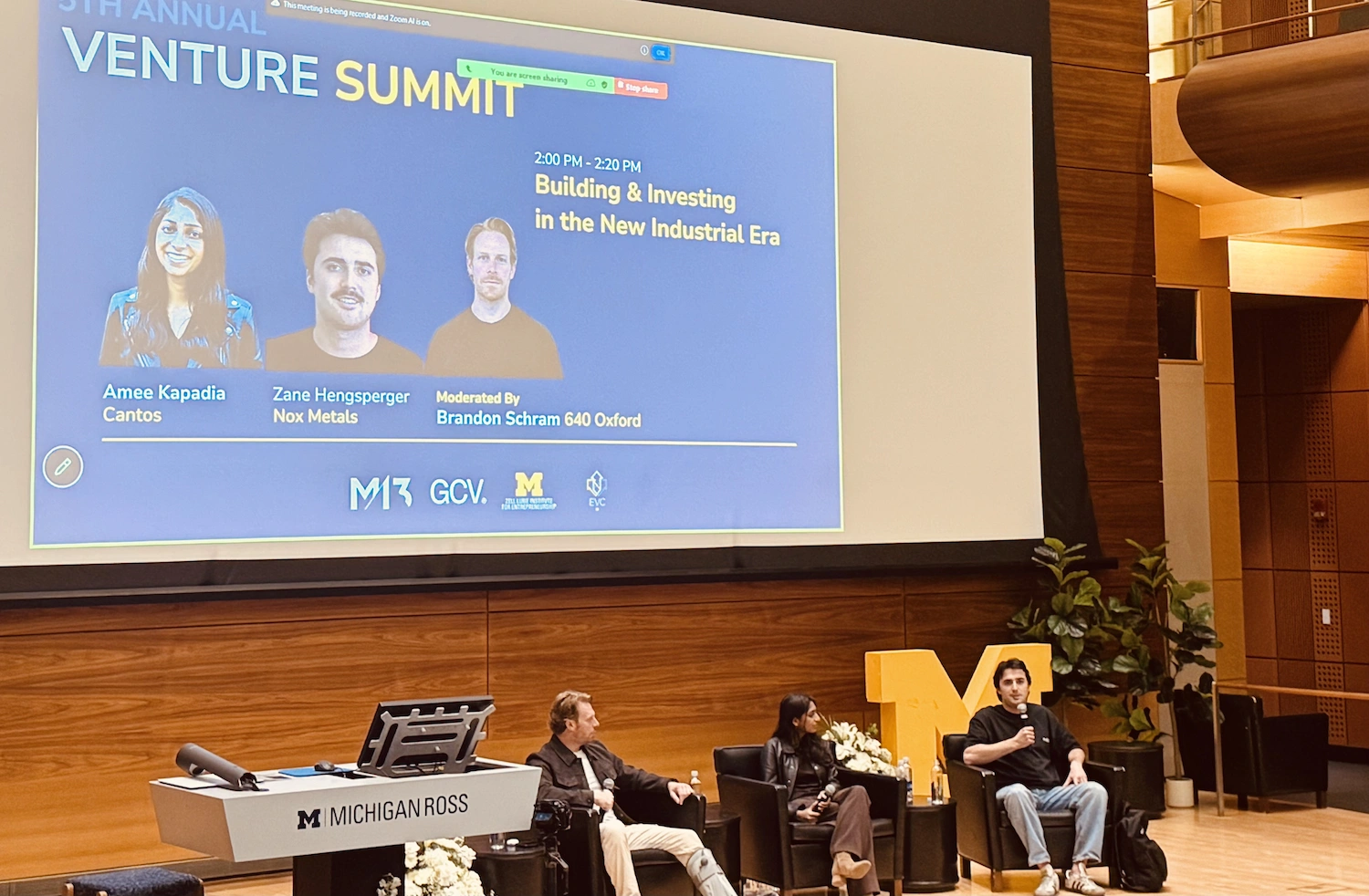
Back in Ann Arbor, Zane Hengsperger of Nox Metals offered his solution to the recruiting problem. Speaking on a panel about building in the new industrial era, alongside Amee Kapadia of Cantos and Brandon Schram of 640 Oxford, he said he wants to "make manufacturing cool again" and described his company's marketing deliberately becoming a tool to attract the best talent. For a region whose advantage lies in industry, this strategy may matter as much as any funding program ever could.
Where startups meet legacy industry
The Midwest's clearest structural advantage is its concentration of large companies in health care, manufacturing, finance, energy, logistics, and food. In Minnesota, Weber argued that this diversity makes the region more resilient in uncertain markets. Grove described Bread and Butter's model of pairing big corporations with startups that can solve their problems, and suggested Minnesota should court companies willing to open a second headquarters near those customers.
Access, though, is not the same as adoption. That gap will be the focus of the panel Start Midwest will moderate at JumpStart VC Fest next week, titled "The New American Industrial Economy: Where Legacy Industries Meet Frontier Innovation." It brings together Abbi Failla of EASE, Casey Klein of Marathon, Guru Vasudeva of Nationwide, and Eric Girard of KeyBank to cover logistics, energy, insurance, and banking.
The discussion will examine what large companies look for in startups, where those relationships stall, how strategic investment differs from traditional venture capital, and what it takes to move from a first meeting to a pilot and then to enterprise-wide adoption.
Weber raised one more obstacle in Minnesota worth noting: coverage. He pointed to fewer national writers covering startups and to local media he feels spends too little time on the startup community. Our publication, which is a media partner of VC Fest, exists largely because of that gap.
Across these three events, our region's investors - and those working outside it - are describing the same problems from different angles. Capital is an issue although perhaps not the most important, and so the question is whether founders, employees, corporations, and the institutions that hold the Midwest's wealth are willing to work together and build companies that stay and scale.