.webp)
Our Founder Stories aim to tell the story of the person first, before the business. We even tell subjects exactly that when we first approach them, and again as we begin our interviews.
Nikhil Teja Kolli - co-founder and CEO of retail security software MokSa.ai - is an impressive entrepreneur, of that there is no doubt. His business has 10x its revenue in the past year including contracts with major security businesses and Fortune 500 retailers, and their most recent fundraising round of $2 million was over-subscribed. But this might be the first time where one of these stories of resilience has the previous generation echoing so clearly through their words. This is what makes it special, because it is also partially the story of Kolli senior, the founder.
Nikhil believes in karma. It's an ethos he inherited from the practical life lessons of Kolli senior. His Dad was a farmer, but when lack of rain impacted his crops, he sold his land and moved the family to the city - Hyderabad, in south-central India - where he started over again, delivering milk.
As that business grew, his attitude to life and business was of someone who never forgot where they came from, and that rubbed off on his son. "I never saw him frustrated or angry," Kolli remembers. "It is his karma … If it happens it happens. If it doesn't, it doesn't. We cannot control the outcome, but we can control what we're going to do with it." And so his father hustled, "every single day, no matter how difficult it is."
Milk runs at 3 a.m.
From the age of 11, Kolli jr. woke up at 3 am to help his father on the delivery rounds, collecting pocket money in return. By the time he left for the United States, the business that had started with one or two liters a day was supplying more than 5,000, and the routine never left him. "Even now I wake up … 4:00 a.m. without even an alarm clock," he tells us. It's an adaptive habit, as it now helps him sync with the working hours for some of his India-based engineering team.
His original plan wasn't to become an entrepreneur. He wanted to be a pilot, dreaming of being in the air was a thing that felt distant and intangible to him as a kid… and thereby intoxicating. But there was a problem - he needed glasses to see from a young age, which meant he was ineligible to fly. His workaround was aeronautical engineering. If he couldn't fly the planes, he figured, then he would build them. After gaining his bachelor’s degree in 2015, his father lent him the money to go to the US for his master’s. Only after beginning his studies at Pittsburg State University, in rural Kansas, did he realize how difficult a career in the field would actually be for a non-US citizen due to national security regulations. "I told myself, s***, I'm back to zero now," he says of his second big setback, but it was one that would soon come to seem trivial.
"It is what it is"
He worked at a liquor store to support himself during his master’s — often up to 16 hours a day, for a minimum wage of around $7 an hour — where he was held up at gunpoint twice. After the second incident, he confronted the liquor store owner, whose response stunned him. "He said, 'Nikhil, I don't know what to say. It is what it is. It's the cost of doing business. Even if you die, there's nothing I can do.'"
His parents back in India were oblivious to these threats. He was the first in his family to make it that far from home, and he didn't want them to worry. Only several years later did he eventually tell them of the harrowing experience.
Instead of accepting the owner's response as the mere 'cost of doing business', he used his father's mantra of not controlling the outcome, but instead controlling what can be done with it.
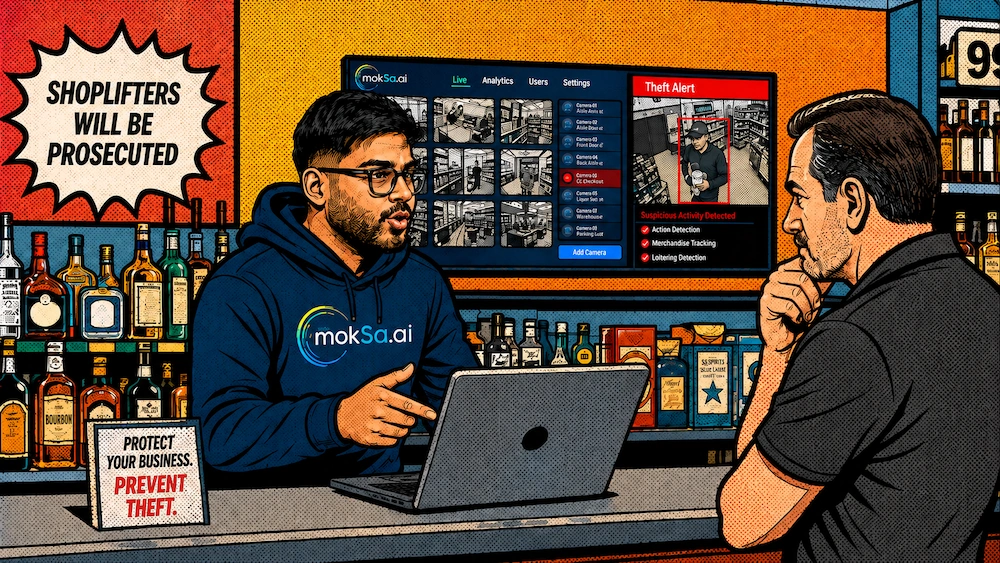
He recruited some friends in India to watch the store cameras live, around the clock, whereby they would call the business if someone stole something, with the police notified if anyone pulled a gun. Within three months, he says, they had stopped more than $10,000 worth of shoplifting across the owner's five or six locations. The owner who told him 'it is what it is' was himself stunned. "He said, 'Nikhil, this is amazing. I want this service to be across all my stores.'" From there the monitoring service grew to 80 customers and a team of 100 people working around the clock — all while Kolli finished his master’s degree, and continuing as he began his first full-time job.
That job was in Michigan. After graduating, Kolli looked at a map, identified Detroit as a manufacturing hub, and drove there in a PT Cruiser stuffed with everything he owned.
Staying was part necessity — he needed a job to remain in the country legally — but it was also the only way to keep building momentum in what would become MokSa: "the risk of not seeing this through would have killed me for [the rest of] my life."
He became the first US employee of Omer, an Italian rail manufacturer which was opening a Michigan operation, and where "I ended up building high-speed trains for a living for almost eight years." With no budget and no playbook, Kolli did everything from buying the furniture in the office to driving forklifts to managing the plant, all while growing the operation from zero to $8–10 million in annual revenue over a six year period. It was, in effect, an apprenticeship in building a business from scratch.
Meanwhile, his manual monitoring service had hit a wall with only so many hours in the day for each team member. A breakthrough came when his MokSa co-founder, Kranthi Mottu, took a deeper look at what they had accumulated over those years: tens of thousands of verified shoplifting clips. "He looked at the data and said, 'Nikhil, we're sitting on a gold mine.'"
That dataset became the training material for what is now MokSa.ai. It is software which makes existing CCTV cameras "intelligent and actionable" in his words, through artificial intelligence. The word comes from the Sanskrit for liberation and Kolli is adamant that in liberating their customers from security issues, the product does so by objectively looking at behavior, rather than people. "It does not matter how you look — white, black, brown, it does not matter," he says. Rather, it tracks whether a product is in hand, and when merchandise disappears it checks the preceding action against the database of shoplifting behaviors; a match with a dataset that recognizes questionable actions - that goldmine of training data from real incidents - and then pushes a notification to the business. It is a solution both efficient and elegant in that efficiency, and big customers are starting to line up for it.
One in ten, not one in a thousand
From the description of what they'd built and Kolli's own personal story of resilience, you'd think raising funds would've been a cinch. It wasn't. "I met almost every investor that I can find in Detroit and the Midwest. I pitched in tons of pitch competitions. Nothing … like literally nothing." It's a common frustration we hear, in a state that led the Midwest in Q2 2026 startup funding off just 14 deals.
The first check he received ultimately came from the coasts: that oversubscribed $2 million round in early 2024 was led by San Francisco-based Array Ventures, with participation from Detroit resident and former Quicken Loans and Rocket Mortgage CEO, Jay Farner. Kolli finally went full-time on MokSa the moment the funding landed — and immediately faced pressure to relocate to San Francisco, where advisors argued that the money, talent, and customers, which investors could introduce would be within easier reach than in Detroit.
He visited the Bay Area, but came back — the same call StockX co-founder Chris Kaufman made a decade earlier. He didn't want to move and it wasn't just stubbornness. "If I have to build a company that's going to make a difference, then I have to stand out. I cannot be one in a thousand. I have to be one in, let's say, 10 really impacting companies in [this] region," he says, adding that "I came this far without [being in] SF."
What keeps him in Detroit - one suspects - is partially motivated by the fact that he chose to come here after his master’s, as a means to staying in the country, and the city then became his home. He's also clear on the misconceptions about Detroit, saying that people think that "the companies in Detroit or Michigan are very good with manufacturing but not with tech." His counter-argument is his current customer list: MokSa is running in stores across the country from SMBs to Fortune 500 retailers. This includes a major national department store, active pilots in a global convenience chain, and a contract with Global Security Solutions (GSS), a major supplier of security and loss prevention services for retailers in the US, Canada and UK.
He goes on to describe a close-knit group of Detroit founders who trade stories and help each other regardless of who has raised what, as well as a local work ethic he recognizes from his manufacturing days, when team members he hired did whatever was necessary to get the job done. "The camaraderie around Detroit, the hustle around Detroit never died. That is what keeps me going." He's also honest, though, that the thought of leaving has crossed his mind "thousands of times," but that if he leaves, it will only be on his terms. "If and when it's time to leave, I don't want to leave because I cannot make it here. I want to leave after making it here."
That focus on the end result conjures images of his Dad's resilience. And somewhere down the line - after all the work is done - there's still that pilot's license to finally earn. We've no doubt he will have earned it.
About Endeavor: Endeavor selects, supports, and invests in the leading high-growth founders building in elsewhere markets around the world — a selective network of 3,100+ founders across 50+ markets with access to global expertise, markets, and capital. Endeavor's network has produced 90+ unicorns, including the first in 15 countries, and backs its founders directly through Endeavor Catalyst, a co-investment fund with $850m assets under management that invests alongside leading global funds like a16z, General Atlantic, Insight Partners, and SoftBank. Endeavor Midwest serves MI, IL, MN, and WI.